

[ad_1]
In June the Fondation Beyeler opened Little Room, a new virtual reality (VR) installation by Jordan Wolfson. Known for confronting his audiences with uncanny and violent experiences, here the Los Angeles-based artist brings viewers face to face with themselves. Visitors undertake a full 3D body scan then, with a friend or stranger, they enter a VR world where they see themselves through the eyes of their partner.
Where many of Wolfson’s past works have featured imaginative and disturbing imagery, Little Room is notable for its spartan appearance. Its intensity comes not from a particular visual style but the feelings of acute corporeality that it elicits. For Wolfson, it is such feelings—not the complex technologies used to bring them about—that make Little Room significant.
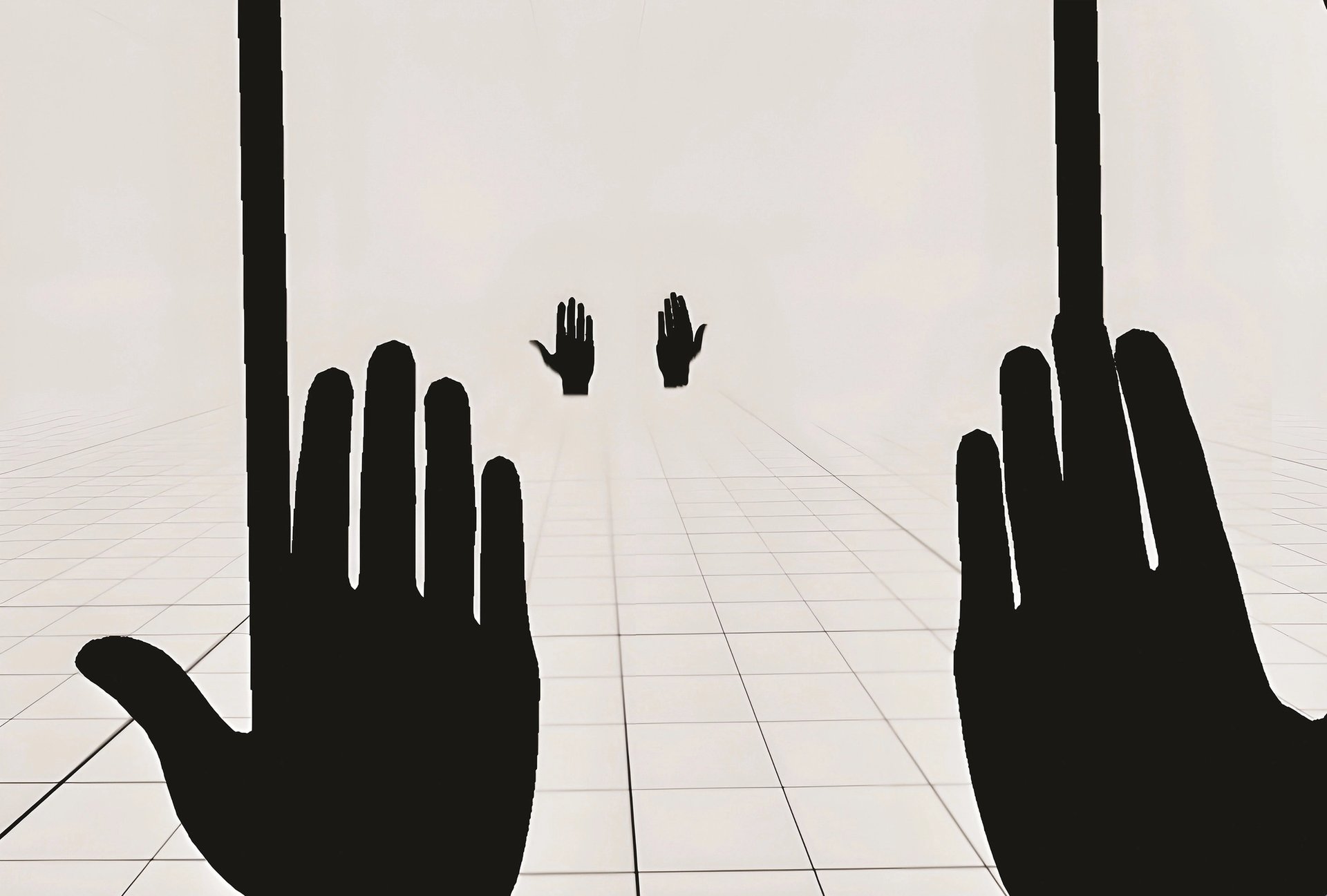
An image from the virtual reality environment that is integral to Jordan Wolfson’s latest work, Little Room © Jordan Wolfson; courtesy of Gagosian, Sadie Coles HQ and David Zwirner
The Art Newspaper: Can you describe how viewers will experience Little Room?
Jordan Wolfson: Basically, you switch bodies and embody someone else. When you see yourself, you’re wearing your partner. I guess the work starts there: what it feels like to embody another person, which is quite strange. The technology exists in pieces. It’s like an assembly line—from a photogrammetry scan, to creating the avatar, to rigging it and allowing an individual to wear it within an AI motion-capture setting.
In this work, you eschew the sort of fairytale-horror aesthetic of some of your past work. It feels more austere and hardware-driven—it feels like the experience itself is the active ingredient. Is that fair to say?
It has no aesthetic. It’s not beautiful, it’s not ugly, it’s a very indifferent aesthetic. If you really wanted to boil down what artworks do, they’re essentially people having experiences between their consciousness and their physical selves. The best thing you can do as an artist is set up a situation where things can happen that elicit this combination.
From a technological perspective, how did this work come to be?
I’ve been trying to make it since 2017. Every year, I checked in again to see if the technology was ready, and this year it was. I thought the work would be dramatically different from the way it turned out. You have to work with what you have; you get an idea, an intuitive download, and 20% of it works and 80% of it you have to throw out and create more intuitive stuff on the spot to fill it in. The general experience is retained from the original idea. You have all these plans, but then the work asks you to do different things. You have to be open to that; you can’t be brittle about it.
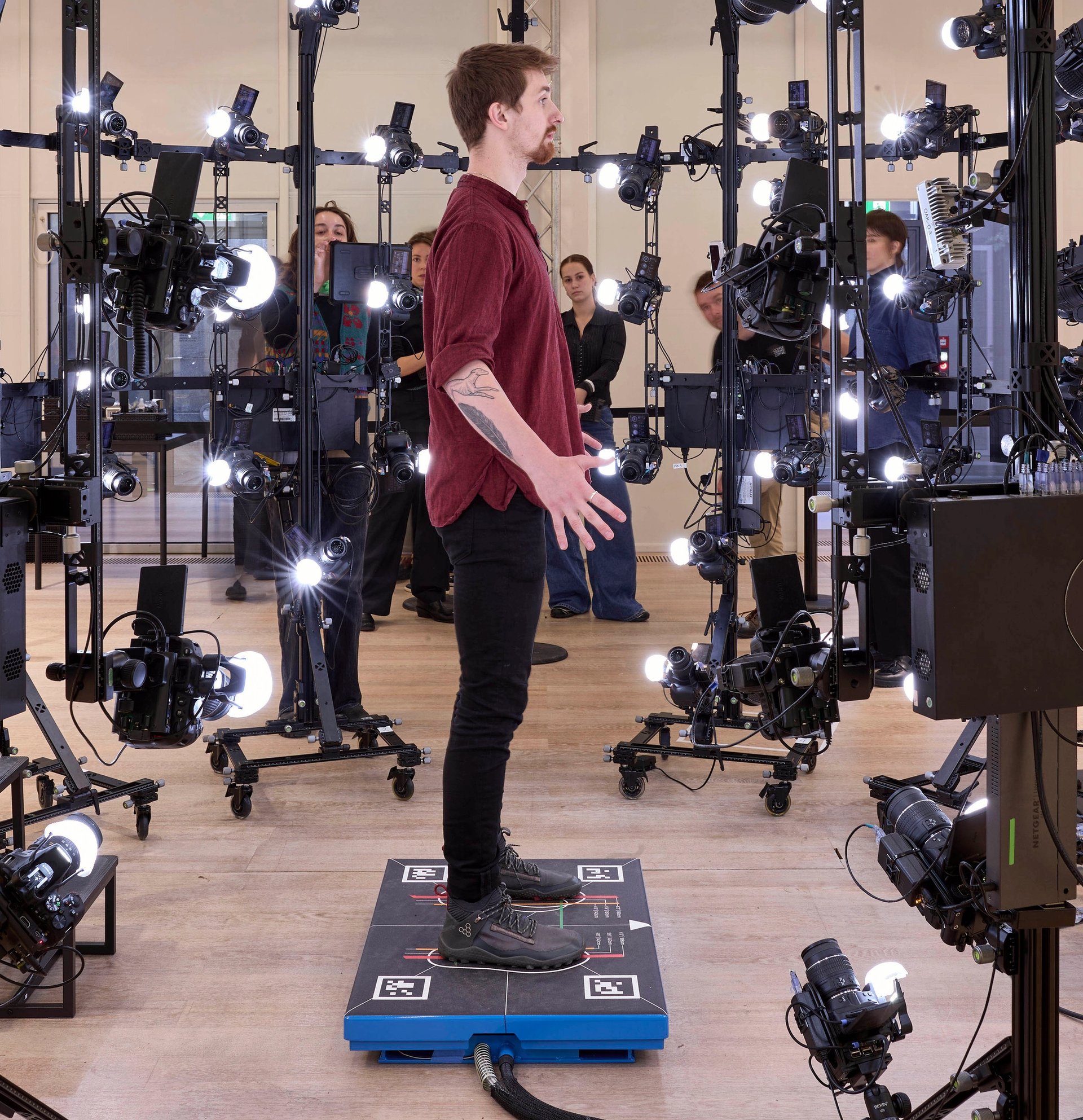
Visitors who choose to engage with the Little Room installation are first given a 3D full-body scan, which allows them to “inhabit” the body of another participant in a virtual-reality environment Mark Niedermann
How interested are you in the technology that underpins a work like this?
The ideas that I have for artworks aren’t ever founded in technology; they’re founded in a kind of formal experience that I want to create. In order to do that, we have to use technology.
I remember when Elaine Sturtevant was alive, one of her last works was this video installation called Elastic Tango (2010). When you see it, you can see that she’s not held prisoner in any way by the technology that she’s using, because she’s using it as a means to an end.
Nothing matters except what happens when a person stands in front of the work. Having an attachment to a novel aspect, having any attachments other than to the formal experience of the work, I would say, paralyses the viewing experience.
Is this where some artists who incorporate novel techniques and technologies like VR into their work are going wrong?
Yes, most of the time people are solely engaged in the novel qualities of the work. Another reason why VR art specifically fails—a pragmatic one—is that VR is, by its nature, an interactive medium. Interactivity mostly doesn’t work in art. It shuts off that part of us that engages with art. There’s this passive switch in us that lets us look at art, and VR usually makes that thing active. You’re then suddenly in a tactile, pedagogical experience. That’s the most difficult thing about VR: washing the interactivity out of it.
Another attachment that you have historically rejected in your work is intellectualism. Does that apply here, too?
I’m not interested in what makes something work; I’m interested in the experience of it working. It would be a fool’s errand to jump ahead and say, “It’s about this.” I don’t know what it’s about, but I know how I felt when I made it. Making art is a very scary, unsure thing. Artists try to protect themselves by getting onto this frequency of knowing. But an experienced artist doesn’t ask why they’re doing something.
Working in such an intuitive way must make it difficult to know when something is finished. Do you experience a particular feeling as a project nears completion?
There’s a part where it sort of compounds and gels. I become locked into it. I just feel it. I can’t really explain it; if I could, I would be able to do it easily over and over again. There’s no shortcut. Each time I do it, I’m a beginner. Every time. I’d like to say, “Oh, that’s how you do it,” but you have to reinvent it every time.
As viewers, we might assume that the artist embarks on the work knowing more or less what they want to achieve with it and how. Little do we know…
Little do you know that the person making it was really walking blind through the dark. Everyone, including galleries, artists and curators, thinks that an artist can just go to the studio and make a work and walk out and that’s it. I have no clue what I’m doing, and I mean that in a positive way. It’s very scary, but once you accept that you really have no clue—and I don’t mean to rhyme but—you allow yourself to become new.
• Jordan Wolfson: Little Room, Fondation Beyeler, Riehen, until 3 August
[ad_2]
Source link