
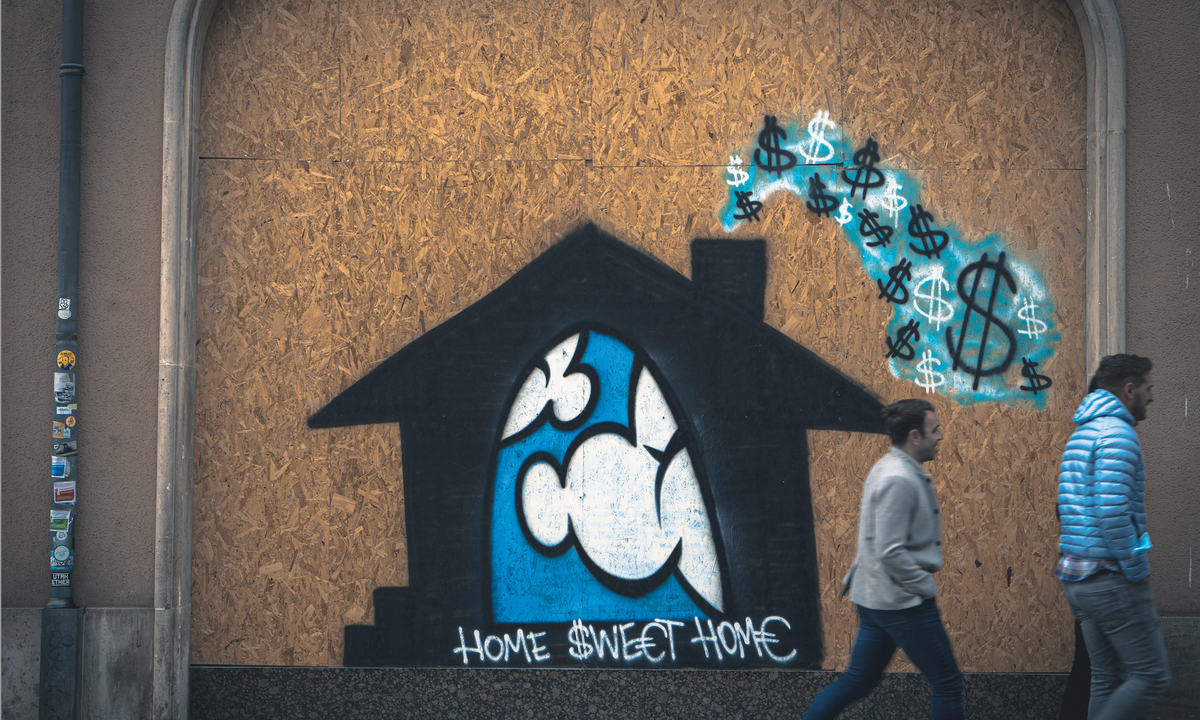
Over the past 12 months, prices in America have increased by a staggering 6.2%, an increase not witnessed since 1990.
This inflation of costs appears to be gaining momentum. On November 10, 2021, a Consumer Price Index Report released by the US government showed a 0.9% percent increase in consumer prices. September saw a 0.4% increase, whilst October saw a 0.6% increase.
The statistics have startled economists and heaped pressure on the previously optimistic Federal Reserve and the Biden administration
The government had hoped inflation would abate as the economy opens out after of the Covid-19 pandemic, but supply chain upsets and greater demand than supply have led to food, fuel, rent and energy increases.
If the present trend is an indicator of what’s to come, policymakers may be pressed to increase interest rates more quickly than anticipated.
The risk, then, is one of a continual spiral upwards, whereby wages increase to keep up with the rising cost of a broadening scope of consumer goods, which in turn means prices continue to increase to cover operating costs. This prospect could send show waves through the US consumer base.
What implications might this have for the art market, which, over the recent and fair season, has demonstrate itself be in robust health and seemingly poised for immense demand-driven growth in the coming year?
“There are two ways inflation affects the art market,” says James Goodwin, art market lecturer and author of The International Art Markets: The Essential Guide for Collectors and Investors.
“There’s the measurement of it against other asset classes, and the bigger picture of how inflation affects economies.”
Goodwin, an art historian, has studied previous periods of inflation in Europe and America: “Inflation corrodes people’s savings and is risky to their investments, which is what people are worried about at the moment,” he says.
Goodwin noted that, historically, the art market has initially remained unaffected during bouts of inflation. But then, in subsequent years, the market has become adversely affected during periods in which the rate of borrowing increased in order to curtail inflation, causing economic growth to slow.
This can lead to a phenomenon known as stagflation—a term that has become prevalent in the vernacular among some economists in recent months. Stagflation was last prevalent in the 1970s.
“The art market has historically gone through cycles, and there are potential headwinds,” said Evan Beard, the National Art Services Executive of Bank of America.
“One potential headwind is an interest rate cycle where rates rise precipitously over the next few years. That will not only make owning art more expensive, but will also mean the opportunity cost of owning art will be more expensive” said Beard.
In this case, Beard warns, collectors may either have to restructure their collection or rely on long-term appreciation.
During periods of economic uncertainty, the question of art’s potential as a salient hedge against inflation is bound to become more relevant, as investors consider options to lower their risk and increase returns over time.
On the whole, history suggests art is a storer of value – an asset comparable to other assets like precious metals. Art sold at auction, specifically by artists established in the art historical pantheon, tends to exceed inflation rates in the long term.
But the global art market is broad and multifaceted, comprising countless sub-markets. Ultimately, the value of art is influenced by a number of variables that are generally too complex and volatile to use as a basis for prediction.
Doug Woodham, Managing Partner of Art Fiduciary Advisors, a New York-based firm that provides financial consulting to art collectors and institutions, advises that investors, specifically those new to the art market, do not attempt to time their art purchases around their inflation expectations.
For those seeking a pure inflation hedge, there are better alternatives with lower transaction costs, Woodham says. These investors would be better advised to invest in real estate, inflation-indexed bonds, and equities.
“It’s very hard to pin down in a scientific and thoughtful way the actual relationship between art prices and inflation,” he says.
A much debated cast study of art as an investment vehicle occurred in 1974, when, during a period of rampant inflation, the publicly-owned British Rail Pension fund invested nearly 3% of its holdings, equivalent to £40 million in Impressionist paintings, prints, drawings, and furniture. The investment paid off with an impressive 13.1% return per year (6% adjusted for inflation).
But, because the investment was highly controlled, individual collectors should be wary of regarding this as proof of art’s power as an investment—rather, the experiment might more aptly illustrate the precariousness of the art market.
British Rail’s timely sale of the collection in 1989 was done at the height of the speculative boom of Impressionist paintings, one fuelled by Japanese collectors, yielding an annual return of 20.7% in this category.
The case study reflects that price indices typically indicate that art outperforms inflation. But these reports are generally not a sound reference for investors looking to gain insight on how to turn a profit, as they tend only to include lots that performed well at the top end of the market.
A 2013 paper published by Yale University addressed the effect of selection bias at play in market indices, illustrating the importance of correcting sample selections when investing in illiquid assets.
Using a sample of 20,538 paintings sold at auction between 1972 and 2010, the report found that artworks which saw higher appreciation were more likely to trade, skewing the estimates of returns upwards to 10%, as opposed to the corrected average annual index return of 6.5%.
Another factor for investors to consider are the costs to unlock capital from artworks, which can be astronomical compared to other investment strategies.
“Art is not necessarily a commodity, so it’s not necessarily an investment,” says Beard. “It doesn’t pay you a dividend, so the correlation with inflation is not clear.”
Historically, the price of art has risen in inflationary times, which might correlate with the present expansion of money supply paired with low-interest rates, creating an environment where opportunity costs are low.
“But art is a classic sentiment-driven asset,” says Beard.
The art market is driven more “by the wealth effect and the amount of disposable income at the ultra-high-end of the pyramid,” Beard says, “which can sometimes be divorced from the overall economic structure of the global market.”
“Currently, the overnight minting of ultra-high-net-worth individuals is happening at a record pace,” says Beard. “This is being driven by an acceleration of growth in the private equity space, and the acceleration of old-line companies being digitized and globalised for scale.”
The result, he says, is “a global wealth environment that is bullish for art.”
“The real driver of the art market is surplus wealth, and what inflation does, of course, is reduce the value of money,” says James Goodwin.
The question that remains to be seen is how long inflated prices will persist, and whether it will have long-term effects on the pockets of potential buyers, who ultimately determine the value of art.
More profound, perhaps, is the question of what will emerge as the market becomes more globalised. But, on this, Goodwin holds an optimistic outlook, inviting the potential for a more diverse market increasingly influenced by different cultures and varied aesthetic philosophies.
“The key to the art market is understanding that culture and taste have more value than anything,” he says.