
[ad_1]
Would you buy an asset where valuation is a dark, subjective art; where most of that market’s data is missing; where prices are volatile and open to manipulation and where you have no guarantee of being able to sell it; all to achieve average annual returns of around 4%?
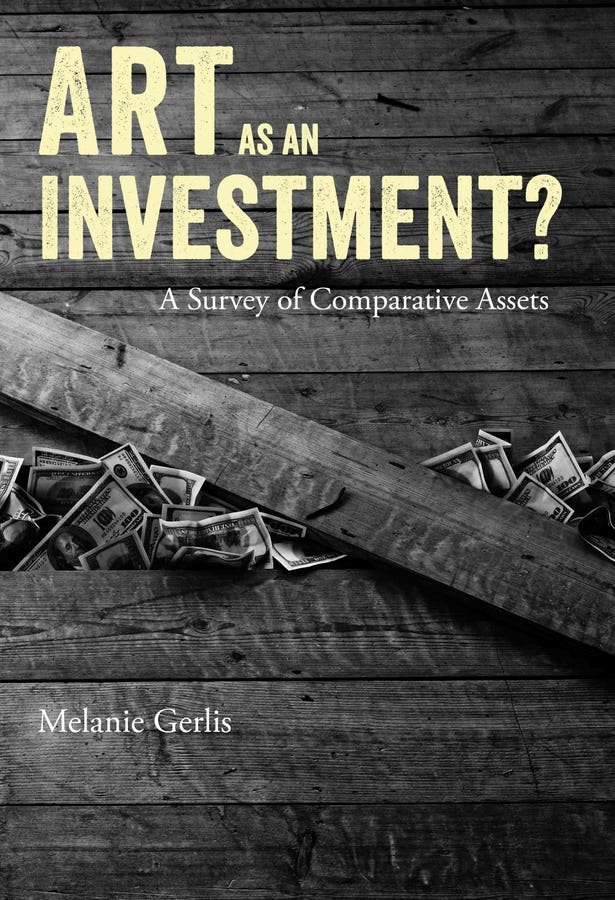
In the introduction to her new book, Art as an Investment? A Survey of Comparative Assets, out in the US this month, Melanie Gerlis explains that after she described the little-discussed risks of art investment to a professional investor, he decided that he’d need a return of 50%.
This thorough and measured survey from Gerlis, who is art market editor at The Art Newspaper, looks at the risks of art in comparison with a number of other assets, including equities, gold, wine, private equity and real estate, and how these comparisons have fallen in and out of favor within the art investment community as the economic environment has changed.
Art, for example, was seen as a great vehicle for capital appreciation, much like equities until the market crash of 2008, when it was suddenly necessary to disassociate art from the stock market blood bath. Since then, art has been mostly billed as a vehicle for wealth preservation, which is ‘as safe as gold’. In fact, she concludes that “both, either and neither can be true for any particular work, artist or movement depending on factors largely outside the control of most investors.”
And while art does share some characteristics with many of these assets, they tend to be rather more challenging ones. “Art has no intrinsic worth but, unlike gold, is a market comprised of unique objects rather than supporting a market that can be commoditized,” she writes. “It is a heterogenous good, like property, but without property’s actual and economic utility.”
Within this framework, she addresses everything from the paucity of data available on art sales and the composition of different art indices, the limitations of art and wine funds, the steep costs of buying, selling and owning art, the decline of speculative investment in the Chinese art market and the vagaries of art prices, which in the auction room, can be influenced by anything from low estimates to bad weather.
Crucially, she points out that the people armed with the most information in the art market are the dealers, who also happen to set the prices; not the investors, who are typically outsiders looking in. Auction houses aren’t level playing fields either when dealers can bid up work by their own artists and third-party guarantors can bid up works in which they have a financial interest. She describes it as “a market that thrives on asymmetry of information” and that “there is a large body of powerful players in whose interest it is to preserve the opacity.”
Given this dynamic, I asked her this week about how the book, which had its European launch in January, had been received so far by those art market insiders. “I struggled to find someone to host my book launch, put it that way,” she says. “People in the art market don’t want to be too associated with anyone who overtly says art is a good investment, but they certainly don’t want to be associated with anyone who suggests it’s a bad investment. Privately, though, they’re saying to me ‘well, we’ve been thinking that for some time’.”
In fact, many of the issues discussed in her book play out in the art market on a daily basis. Gerlis points out that the unpredictability of art prices were on display again during last week’s contemporary auctions in London, when Christie’s sold one work by Alberto Burri and Sotheby’s sold another.
The Burri painting sold at Christie’s fetched $7.6 million, while the one at Sotheby’s fetched $6 million, even though the Sotheby’s painting was, on the face of it, more desirable and carried a higher estimate. She says the price difference was probably because the work sold at Christie’s came from an important collection. “That’s something that Scott Reyburn rather brilliantly called the ‘almost nostalgic premium’ for works from such collections, but try incorporating that into your risk management software!”
The book is certainly not all doom and gloom for art buyers, but more a cautionary tale for anyone tempted to buy art purely as an investment. Gerlis also thinks that if the art market is ever going to become a globalized, mass market, it will be forced to become more transparent eventually.
She just doesn’t see any evidence of that yet. “If this is going to be more of an online market, you can’t have all this asymmetry of information, yet even some online sites are secretive about prices and their ownership,” she says. “Then you have auction houses increasingly moving into private sales. The problem is actually becoming worse.”
Art as an Investment? A Survey of Comparative Assets by Melanie Gerlis is published by Lund Humphries and available in the US on February 28.
Follow me on Twitter or find me on Facebook.
[ad_2]
Source link