
[ad_1]
You made it time. If you want to look a little longer, just scroll back up and press “Continue.”
More than 60 of Kerry James Marshall’s paintings are on view through January at the Royal Academy of Arts in London. “If one spends the time and looks at the work closely enough, there’s nothing that’s not available,” he told my colleague Aruna D’Souza for a recent article about his show.
Let’s take his advice on the one you just saw.
Mr. Marshall is a modern master — called “one of the great history painters of our time” in 2016 by The New York Times’s chief art critic Holland Cotter — known for painting Black people in bold, bright environments.
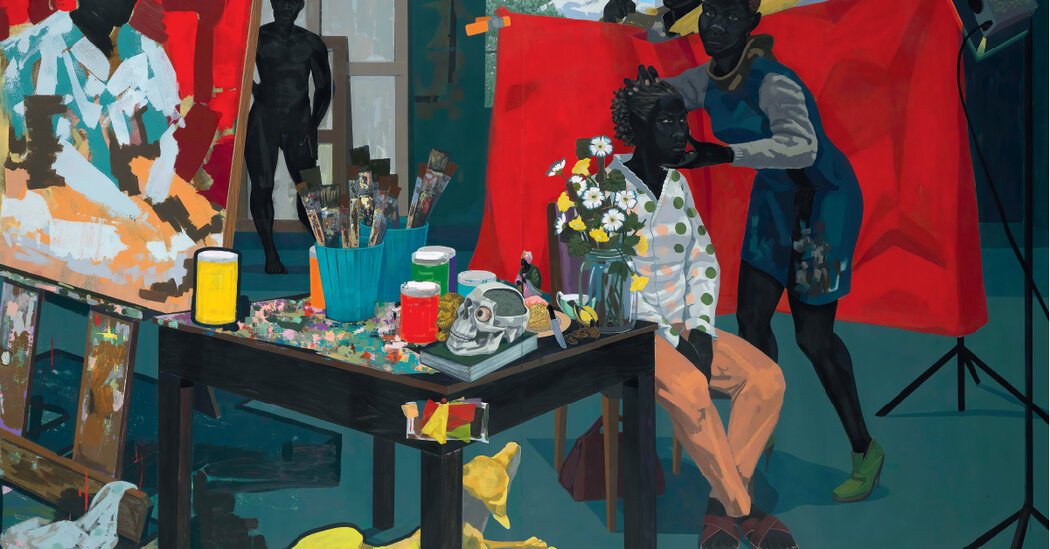
Here we’re in an artist’s studio. A painting is in progress on an easel. A model sits in front of a large red sheet covering the window, and a man is dressing. An artist is in the middle of adjusting a model’s head:
It’s almost as if we just walked into the room, and the heads turned toward us.
Their faces are deep and dark and rich, full of purples and blues and greens (this is best seen in person!) that stand out against the background:
Mr. Marshall uses different types of black paint mixed with reds, blues and violets to expand its range. “I can actually make it complex within the context of the blackness,” he said in a 2016 interview.
When you first see the painting, your eyes may first go to the people looking back at you, but they are just a small part of a bigger, busier scene: a crowded table anchoring the foreground, two large areas of red framing the figures amid a sea of teal.
Starting up near those heads, there’s a trail of yellow that leads you through the composition: the writing on the studio light, the jacket of the man in the back, the flowers, the small bird nibbling on something, the tiny head of Abraham Lincoln, the dog …
… over to this curious yellow jar of paint:
It’s like that old “Sesame Street” song: One of these things is not like the others.
It has a thick black outline around it, as if it were meant for a comic book. The other jars on the table don’t have the same outlines. There’s no realistic-looking shadow to suggest that the yellow jar is actually sitting on the table. It’s not as if Mr. Marshall doesn’t know how to paint shadows or make things look as if they’re sitting on the table. Of course he does. Just look at the rest of the scene.
If you move your eyes down, there’s more thick outlines, on the back half of the dog:
It’s also there on the shadow of the easel:
And what’s that red drip? It seems to be on top of the surface, not inside the scene. There’s more of that below:
There’s a scribbly shadow, some more red drips, and if we zoom back out, it actually looks as if this whole left side of the painting isn’t quite finished — from the shadow below to the in-progress portrait on the easel:
Compare it with the right side, where things seem to be more fully realized:
This is a painting about making paintings — both the painting inside the scene, and the full painting itself.
“What a painter does most of the time is spend time in their studios making things and making decisions about how they’re going to be,” said Mark Godfrey, curator of the London show. “So to make that the subject of a work is really exciting because then they can give a sense of how they approach the making of art.”
You are seeing the decisions that the artist inside the painting is making at this moment: to adjust the model’s head, to block out the window light and construct this scene with a red drape and an artificial light instead.
But you are also now forced to think about the decisions that Mr. Marshall is making to construct this entire picture, like why that yellow paint jar is treated differently than all the others.
Partly, it’s painted that way so you’ll ask that question — and then, in turn, keep thinking about it.
“I never think of the paintings I make as self-expression,” Mr. Marshall said in 2016. “I think of them exclusively as platforms for an idea. Since the idea of representation is really interesting to me, I make a lot of work that’s about that idea. And then I’m also interested in how you reference culture and history in pictures.”
Take the skull, for example:
It’s front and center here. The decision to include it (and then to place it on a book) connects back through the history of still life painting, like here from the Dutch painter Pieter Claesz in 1628:
Up through Picasso in the 20th century:
Artists have used the objects as a “memento mori,” the idea that eventually we’ll all die.
But it’s not just the skull — all of “Untitled (Studio)” is in conversation with the history of art. For Mr. Godfrey, it recalls three specific paintings:
“Las Meninas” by Diego Velázquez from 1656 (at the Prado in Madrid):
The “Art of Painting” by Johannes Vermeer from the 1660s (at the Kunsthistorisches Museum in Vienna):
And “The Painter’s Studio” by Gustave Courbet from 1855 (at the Musée d’Orsay in Paris):
Spend even just a tiny bit of time with each one of these, and immediately you start to see the references. Start with an artist:
Add smudgy paint:
Active canvases:
Dogs:
Window light:
Drape-y fabric:
This guy and this guy:
Mr. Marshall uses these references, but makes them his own. The artist isn’t a white man (and it’s not Mr. Marshall himself). She’s a Black woman. Black faces, let alone Black female faces, were rarely if ever given center stage in all of art history. In Courbet’s painting (and throughout art history), women are the nude models. Here, that’s reversed. Traditionally, as with Vermeer and Velázquez, window light was used to illuminate models. In the Marshall painting, the window is shown but covered by the red cloth, and an artificial light is used.
“These other three paintings are some of the most famous paintings in the history of art, and I think Kerry has the absolute ambition to say, ‘I’m gonna add another one,’” Mr. Godfrey said.
“There are no Black old masters,” Mr. Marshall has said. By filling this artist studio with Black figures, showing them in the act of creation, he updates a celebrated form.
But then he also incorporates references to more recent art that, in a different way, is also about the act of creation. The red drips and splotchy brush strokes suggest the work of 1950s abstract expressionists like Jackson Pollock:
The flat outlines and bright colors throw back to the 1960s pop art of Andy Warhol’s soup:
Or Roy Lichtenstein’s butter:
The red, green and black of the light echo the colors in the Pan-African flag and the 1990 artwork “African American Flag” by the artist David Hammons:
Mr. Marshall is even showing us different types of categories of painting within the painting, like portraiture (on the easel), still life (on the table) and history painting (the whole thing).
“He packs in the references to provoke thought in front of his paintings,” Mr. Godfrey said. “What I love is that the viewers who don’t recognize the references still have a powerful experience of his work.”
Visitors to the London show will see walls filled with people in settings that are both familiar and strange, old and new.
At work:
In love:
And, of course, making art:
This is an installment in our series of experiments on art and attention. Sign up to be notified when new installments are published here. And let us know how this exercise made you feel in the comments.
[ad_2]
Source link