
[ad_1]
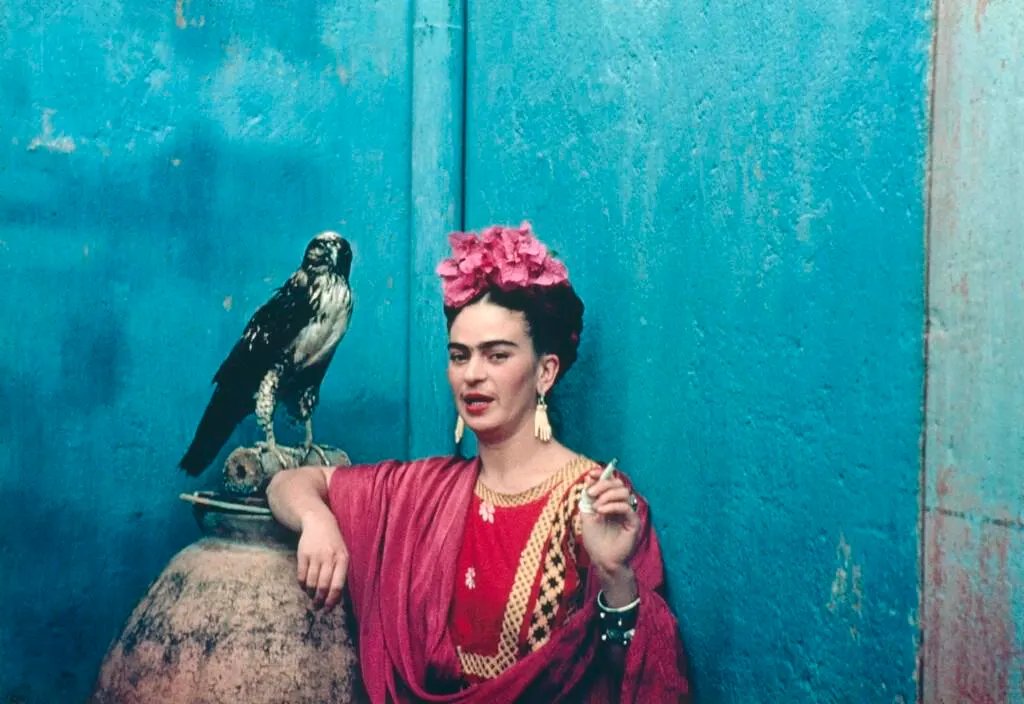
Nickolas Muray, ‘Frida with her Pet Eagle Coyoacán,’ 1939 printed 2024, inkjet print. The Museum of Fine Arts, Houston, gift of Nickolas Muray Photo Archives. © Nickolas Muray Photo Archives
Museum of Fine Arts, Houston
My 17-year-old niece’s favorite artist is Frida Kahlo. She’s never seen a Frida Kahlo painting in person; her admiration comes from a Kahlo jigsaw puzzle I bought her a few years back. My niece likes puzzles more than art.
Since putting the puzzle together, my niece has seen Kahlo’s image regularly on television and tote bags and posters. Kahlo’s image graces tens of millions of consumer products worldwide.
Teenagers acquire favorite artists and athletes and singers and actors through popularity and familiarity. No artist’s likeness in 2026–living or dead–is more popular or familiar than Frida Kahlo. The Museum of Fine Arts, Houston explores how this came to be during the exhibition “Frida: The Making of an Icon” through May 17, 2026. The presentation traces Kahlo’s posthumous transformation from relatively unknown painter to global brand.
“When she died in 1954, she had a very tight, closely knit circle of followers and collectors who loved her work, but it wasn’t until 1976 and 1977 when the first two biographies of Frida appeared in Mexico, and then in 1983 was Hayden Herrera’s blockbuster biography,” Carmen Ramírez, Wortham Curator of Latin American Art at the MFAH and the exhibition’s creator and organizer, told me in a phone interview. “Those biographies brought her to the attention of a new generation of artists and activists who were coming out of the student movements of 1968, particularly in Mexico with the massacre of Tlatelolco, and in the United States from the Civil Rights Movement.”
A quarter century after her death, Kahlo became art world famous. When did she become famous famous?
“It really explodes in the early 90s. In 1990, there’s a big exhibition at the Metropolitan Museum (of Art in New York) called ‘Splendors of 30 Centuries,’” Ramírez explained. “It was an exhibition of Mexican art where her work was featured together with some other women artists that had never been featured in those kinds of exhibitions.”
The show was part of a city-wide festival organized by the Mexican government. The North American Free Trade Agreement was being considered at the time. NAFTA sought to eliminate most trade barriers between the US, Mexico, and Canada.
“There was a big push from business and government interests in Mexico to conquer New York with Mexican art,” Ramírez continued. “The exhibition at The Met was a standard bearer, but there were about 100 other exhibitions throughout the city in galleries and nonprofit spaces. Frida was all over the place. Her Self-Portrait with Monkey (1938) was used in billboards and in bus advertising all over the city. This was the beginning of the ‘Fridamania.’”
One gallery in the exhibition devoted to “Fridamania” displays more than 200 objects generated by the global, mass-market production of Frida Kahlo merchandise.
Kahlo had one more critical accelerant fueling her rise to icon: Madonna.
“To top all of that, in the early 90s, Madonna becomes involved with Frida,” Ramírez said. “She buys two of her artworks and she introduces Frida to the celebrities of Hollywood and the fashion world.”
Artist, Then Icon
Frida Kahlo, ‘Diego and I,’ 1949. Oil on canvas. Collection of Eduardo F. Costantini. © 2026 Banco de Mexico Diego Rivera & Frida Kahlo Museum Trust, Mexico, D.F./ Artists Rights Society, New York
Banco de Mexico Diego Rivera & Frida Kahlo Museum Trust, Mexico, D.F./ Artists Rights Society, New York
“The Making of an Icon” features 35 works by Kahlo capturing the arc of her artistic legacy within the context of works by successive generations of artists: painters, sculptors and photographers from an array of artistic and social communities and movements. All felt a kinship with Kahlo and mined her paintings and personal history.
“There are 80 artists in addition to Frida in the show, and those artists comprise the Surrealists, the Chicano/Chicana’s, the feminist women artists, the LGBTQ (artists), the disabled artists, contemporary artists, Latinx artists,” Ramírez explained. “Her legacy and her rise to becoming an icon is seen through the work of these five generations of artists.”
Photographs and archival material, including the artist’s clothing, jewelry and other personal items from Kahlo’s personal collections and other sources provide additional context. Together, the items reveal how the artist carefully crafted and projected an image long before personal branding was a thing.
“She was very deliberate about the way that she constructed herself, and she constructed a multi-faceted personality,” Ramírez said. “She was the avant-garde artist and intellectual. She was the devoted wife. She was a mestiza; she was a bisexual partner. She was many, many things, and that allows people to connect with different aspects of her personality.”
The multiple angles from which to connect with her life and personality has allowed a great diversity of groups to claim Kahlo. For artists, however, one through line exists in their admiration.
“Frida tells her own story through her work which allows many artists to speak from a personal perspective, and (Kahlo) does it with frontality, with violence, and with black humor that many artists have absorbed,” Ramírez said. “She created her own character, and she tells her own story, and she puts herself out there.”
Did she ever.
Kahlo ranks among the handful of best self-portraitists in art history along with Rembrandt and Van Gogh and Francis Bacon because she, like them, depicted herself with total vulnerability. Raw. Exposed. Uncomfortably so. The dinner party guest you’ve just met who begins sharing their darkest secrets and traumas within five minutes of meeting them.
“She’s one of the first artists to represent very difficult themes like miscarriage or violence against women” Ramírez continued. “Nobody else had represented those themes before and she does them in a very upfront way. That is something that fascinated artists because it gave them liberty to be who they are and to tell their own story, whether they were disabled artists or whether they were women or whether they were LGBTQ artists that were coming out, she gave them the freedom to do that. We hear that over and over again (from artists).”
Kahlo’s biography as inspiration.
A life of pain.
The polio she was afflicted with as a child leaving her with a limp. The near-fatal bus crash at 18. Impaled. Her spine and hips and neck crushed. Kahlo would endure roughly 35 surgeries during adulthood–an adulthood that lasted only until 47–as a result. She also suffered from alcoholism and pill addition to keep the pain at bay.
Then there was her love affair and marriages and breakups and infidelities with Diego Rivera, the giant of 20th century Mexican art. Rivera’s enormous shadow and how Kahlo came to eclipse it, further grist for the mill.
Her left wing politics and affair with Communist revolutionary Leon Trotsky.
“All of that lends itself to a lot of melodrama, and it obscures the art,” Ramírez said. “Art historians tend to look at her art as an illustration of her biography and that’s very dangerous. The brilliance of her artwork is many times subordinated to her biography. Frida, so much has been written about her that it’s amazing, but a lot of it is based on the fact that her biography was so different and she suffered so much.”
All true.
All extraordinary.
But don’t lose sight of the artwork for the artist. Kahlo may have become a global icon on the back of her remarkable biography, but if the work was mediocre, interest in her would have had a ceiling.
Yasumasa Morimura, ‘An Inner Dialogue with Frida Kahlo (Hand-Shaped Earring).’ Color photograph on canvas, Minneapolis Institute of Art, gift of funds from Beverly Grossman, 2010.25. © Yasumasa Morimura, courtesy of the artist and Luhring Augustine, New York.
© Yasumasa Morimura, courtesy of the artist and Luhring Augustine, New York.
The ceiling on Kahlo’s popularity has yet to be reached.
“The capacity that she has to emotionally connect with people, that is something I don’t know if any other artist has that,” Ramírez said. “Whether it’s my hairdresser, whether it’s the guard at the museum, or the woman who sells the tickets, or the abuelita in Mexico, when you mentioned Frida, they start crying out of joy or sadness. She connects with people in a way that I haven’t seen any other artist connect.”
Connection.
“Fridamania” doesn’t exist without it.
The phenomenon of Frida and how she became an icon long after her death.
How her icon status resulted from a universe of commercial products with her face on them.
“That phenomenon implies this connection to audiences, the popular reaction to her, as well as the commercial aspect, which you cannot separate today. You cannot separate the commercial aspect from the high art component because they’re both intertwined the way people consume her,” Ramírez explained. “Anyone can own a figure or an object with Frida Kahlo’s image and establish a personal relationship.”
Even your teenage niece through a jigsaw puzzle.
Hotel Daphne
Hotel Daphne in Houston’s lobby library.
Julie Soefer
“Frida: The Making of an Icon,” travels to the Tate Modern, London, after its premiere in Houston. Travelers to Houston for the show should consider staying at Hotel Daphne, a 49-room boutique hotel opened in late 2025 in the city’s historic Heights neighborhood.
Drawing inspiration from the Arts and Crafts style, the hotel’s design features stepped parapets, steel windows, and painted brick nodding to the area’s industrial past. Landscape design integrates large heritage oak trees.
Art lovers will appreciate more than 160 pieces from the Ackerley family collection–including Ben Ackerely, Developer of Hotel Daphne–predominantly by Houston- and Texas-based artists displayed throughout the property. Custom upholstered beds with trippy patterned headboards along with a hand-picked mix of antiques and vintage finds bring the artsy aesthetic to guest rooms; a handmade tile-wrapped front desk with a vintage Murano chandelier floating above does the same for the entry.
The Italian-style restaurant, Hypsi, led by two-time James Beard Award nominee Terrence Gallivan, former chef of the Michelin-starred Alto in New York City, nods to the area’s Prohibition-era supper club history. A Tableside Mozzarella Cart serving multiple types of cheeses and seasonal accompaniments is a highlight, while the beverage program showcases Italian wines and spritzes.
More From Forbes
[ad_2]
Source link