
[ad_1]


See the latest news from Your World at https://www.sussexexpress.co.uk/your-world
Firstly, welcome to Brighton, Mandeep. We gather you have moved here recently after having lived in the West Midlands and London. How are you finding the transition? Has it affected your practice?
The transition to Brighton after living in the West Midlands and London has been a significant shift, and I’m finally coming up for air after a major house renovation. The pace is different, and I have more light and space, which has been refreshing. That inevitably affects the work. My practice has always been quite sensitive to atmosphere and subtle environmental changes, so being somewhere new sharpens that awareness.
This is my first Artist’s Open House in Brighton, and one of the main reasons I wanted to participate was to feel more connected to the area. It seems like a good way to meet people locally, both artists and visitors, in a more informal setting than a gallery. There’s also something important about inviting people into a domestic space. It creates a different kind of conversation around the work, one that feels more open and direct, and I hope it might reach people outside a typical gallery setting.

You credit your eventual calling to become an artist to a childhood growing up in a working-class household, which prompted you to create toys out of the few possessions you had, fashioning a doll’s house out of an old suitcase and tinkering endlessly with a broken clock. Has this interest in making things out of odd bits and pieces shaped your artistic process? Can you tell us a little bit about how you work?
I’ve always loved making things from an early age, using whatever was available, and that mindset has stayed with me. There’s still a lot of improvisation in how I approach the work. I tend to look at everything in terms of how it’s put together, or how it might be made differently. My first degree was in design, and that way of thinking persists. Whether it’s designing an interior, gardening or making sculpture, I’m always experimenting with different materials and combining form, objects or structures. That curiosity, and even an obsession with making, is probably a characteristic shared by most artists and designers.
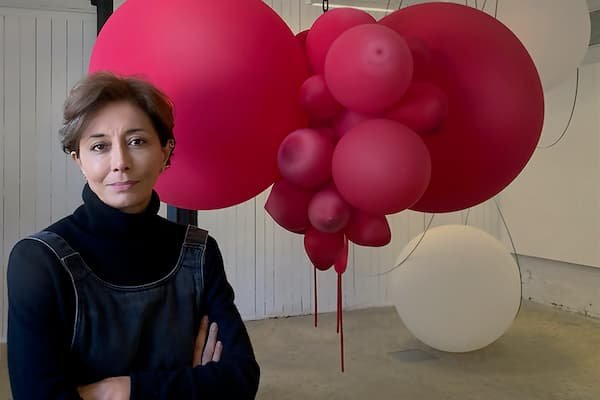
Your practice revolves around creating ephemeral sculpture, often using inflatables, which reflect the transient nature of both human and non-human entities. We are interested in how the limited lifespan of these pieces, which form the very basis of your enquiry, affects your practice as a whole. What is the relationship of these powerful but short-lived works to the more lasting elements of your physical output, photographic prints, paintings and collages? Does it make these, as the only enduring records or responses, more important in some ways?
The short lifespan of the sculptures is fundamental to my practice. The works are ephemeral and often only stable for a limited period, and that sense of precariousness is present in the sculpture itself. They are usually suspended, swaying from a height, or collapsed on the floor, reflecting the fragile and transient nature of life, whether plant or animal. Because of that, the photographic works, collages and paintings aren’t simply records, they become another stage of the work, allowing something fleeting to persist in a different form. The 2D works are not secondary, but another iteration of the work, integral to it and part of the same process, translated into another medium.

You are currently showing your work “Brink” at Hastings Contemporary as part of the Odyssey exhibition, featuring work by over 150 Sussex artists. Can you tell us a bit more about this piece and how it relates to the theme of the exhibition, as well as to the works you will be showing as part of your Open House?
The brief for Hastings Contemporary was to respond to the theme of Odyssey, focusing on coastal life, marine ecology and climate change. I have long felt strongly about our fractured relationship with the natural world, and the precarious nature of my work reflects a sense that we are on an ecological precipice. Brink is a suspended inflatable form that could be read as a deflating wading bird. It has spindly legs that sway above the ground and a deflating body that suggests something close to failure. The work becomes subtly kinetic as visitors enter the space, reinforcing a sense of human impact on the more-than-human world. In relation to the Open House, the connection is quite direct. The photographs and collages I’ll be showing often come from works like this, pieces that exist briefly and are then translated into images. Although the sculpture itself won’t be there, it remains present in the 2D works.
We get the feeling that location is a primary concern for you, not only in the creation of individual pieces, as the inflatable sculptures are highly responsive to subtle environmental changes, but also in their exhibition, which aims to offer the viewer an experience that is both abstract and visceral, and often takes the form of site-specific installations, whether in larger art institutions or more formal gallery environments. Your Open House setting will be very different from many of the venues you have shown in previously. Do you think the more intimate surroundings will impact the way your work is viewed, and will this affect your curatorial decisions? How do you think the more intimate Open House setting will affect how the work is viewed?
Most of my sculptural work is shown in larger spaces, where there’s room for distance and movement. A domestic setting is much more immediate. That has influenced my curatorial decisions. I’ve chosen to show primarily photographic and 2D work, which suits the scale of the space but also brings the viewer closer to the work. I will also have one or two smaller wax sculptures on display. Some of these are unfinished or works in progress, but they may be interesting for people to see.

You will be exhibiting with Tim Minter, an artist who creates generative systems built on simple code that run without his control. As he puts it, “these pieces are not just objects; they’re conversations between code, light, motion and human perception.” Although seemingly quite different practices, you share more than a few formal and conceptual concerns. Was this important to you when looking for someone to share your Open House space, and why did you think his work would be a good fit?
Sharing the space with Tim Minter felt like a natural fit. Although our practices are materially quite different, there are shared concerns around systems, instability and a lack of full control over the outcome. His work evolves through code and generative processes, while mine responds to physical conditions such as air pressure and environment. In both cases, the work isn’t entirely fixed. That connection was important, but I was also interested in the contrast between the works and how they might sit together.
In earlier years, you worked as both a creative director for a luxury brand and a documentary filmmaker, making programmes about design, the arts, and geopolitics in regions including Africa, Asia and the Middle East. These are very distinct, almost diametrically opposed, lines of work, and a world apart from what you are doing now. Have these experiences influenced your current practice, or were you happy to leave them behind when you became a full-time artist?
Although my earlier work may seem to sit in a very different world, I think the underlying skills are closely related, particularly when working with materials, space and composition. My previous roles involved managing complex projects, structuring ideas, and finding ways to communicate them, all of which continue to shape my practice now. Although the subject matter was different, the underlying approach transfers. I don’t see those experiences as something I left behind, but as something that continues to inform the work. I do think making art is much harder. There is no fixed brief, the work is self-directed, often self-funded, and without the support of an organisation. I’d also say that both documentary filmmaking and contemporary art often operate within systems of privilege. Contemporary art is largely consumed by those with a degree of intellectual and financial capital. Similarly, work about political or social issues is often encountered at a distance, engaged with intellectually rather than by those with direct experience of the issues.
Visit: Harrington Road
22 Harrington Road, Brighton, Brighton and Hove, BN1 6RE
No.7 on the Fiveways trail for Artists Open Houses – aoh.org.uk
www.mandeepdillon.co.uk
www.instagram.com/inbuilt_obsolescence/
www.mandeepdillon.com
timminter.com/
instagram.com/timminter
[ad_2]
Source link