
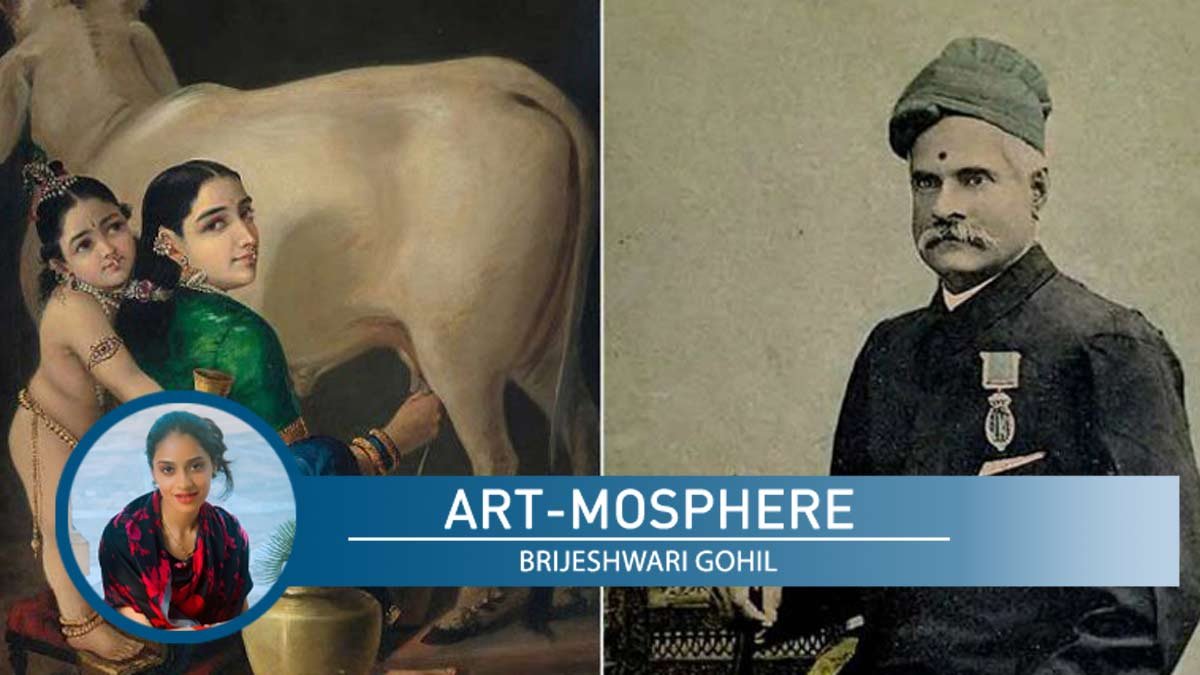
More than a decade ago, in my first full-time role working on an exhibition dedicated to Raja Ravi Varma, I remember studying valuation and insurance sheets with a certain quiet disbelief. The figures, then in single crores, felt substantial, even faintly indulgent. There was, implicit in those documents, an attempt to reconcile two very different ideas: cultural significance and financial worth.
A decade on, with Yashoda and Krishna selling for ₹167 crore, that reconciliation appears, at least on the surface, to have been resolved. The Indian art market has found its headline, until the next record is broken.
But step beyond the headline; the story becomes more instructive and more complicated.
The immediate response to the sale has followed a familiar script: close readings of Varma’s technique, questions on his travels and contributions to royal patrons, reflections on the tenderness of Yashoda and Krishna, and invocations of nostalgia and national identity. On social media, the painting has been reframed, repeatedly, as an emblem of devotion, its emotional clarity amplified, its context simplified.
All of which is understandable. But the thought of writing a piece exploring another one of these facets seemed both repetitive and cumbersome.
Because the moment a painting reaches this level of value, it also enters a different category altogether. It becomes, unequivocally, an asset, subject to the same considerations that govern any high-value holding: liquidity, taxation, cost, and risk.
A figure like ₹167 crore suggests certainty. In reality, art markets trade in approximation.
Unlike equities or commodities, there is no continuous pricing mechanism. Each sale is discrete, shaped by timing, narrative, and the alignment of buyer and seller. Auction houses create the conditions for these transactions, but they do not eliminate their opacity. Buyer’s premiums, seller’s commissions, and, increasingly, financial guarantees complicate what appears to be a single number.
More fundamentally, price does not equate to liquidity. A work may achieve a record today and prove difficult to sell tomorrow. The market at the top end remains thin, highly selective, and dependent on confidence.
This is perhaps the least acknowledged aspect of the art market: selling is rarely straightforward.
A collector seeking to part with a major work must navigate a series of variables. Timing is critical; demand can shift, sometimes abruptly. Provenance must be robust; gaps in ownership history can delay or derail a sale. Condition matters; often disproportionately minor restoration issues can have significant financial implications.
There is also the question of process. Unlike property, there is no standardised pathway to sale. Transactions are negotiated, sometimes privately, sometimes through auction, often over extended periods. It is not unusual for works to remain on the market for months, even years, before finding the right buyer at the right price.
In this sense, art behaves less like a conventional asset and more like a bespoke one: highly valuable, but not easily convertible.
Ownership, too, is more involved than it appears.
Insurance is essential and expensive. Policies must be tailored, values periodically reassessed, and risks carefully managed. Conservation is ongoing. Works of this age and scale require controlled environments, professional oversight, and, occasionally, intervention.
Even visibility carries a cost. Lending to institutions, museums, and galleries enhances a painting’s profile and, by extension, its value, but introduces logistical, financial, and insurance considerations that must be carefully calibrated.
To own such a work is not merely to possess it; it is to maintain it.
If acquisition and ownership are complex, disposal introduces further layers.
In India, art is treated as a capital asset. Gains on sale are taxed accordingly: long-term if held beyond three years, short-term otherwise. The principle is clear; the application is less so.
The central difficulty lies in establishing the cost of acquisition. Many significant works are inherited, often without formal documentation. Retrospective valuations become necessary, bringing with them questions of interpretation and, at times, scrutiny.
Provenance intersects with this. Ownership history is not simply a matter of scholarship; it is a financial and legal necessity. Any ambiguity can affect both value and saleability.
Selling art, in this context, becomes less a transaction than a process—one that sits at the intersection of finance, law, and history.
Where, then, does this leave art as an investment?
Works by Raja Ravi Varma have undeniably appreciated. The trajectory is clear, and the returns, in certain cases, substantial. Yet the conditions under which those returns are realised remain uneven.
Art is illiquid. It is costly to maintain. It requires expertise to buy, and perhaps even more to sell. It can, at times, resemble a white elephant: valuable but demanding.
And yet, it continues to attract capital.
There is an irony in the journey of Yashoda and Krishna. An image rooted in the domestic—in care, in intimacy, in the unremarkable rhythms of daily life—has become the subject of extraordinary financialisation.
But this is not entirely contradictory. It reflects the peculiar nature of art markets, particularly in India, where sentiment and speculation are rarely separate. Value accrues not only through scarcity but through familiarity, through the extent to which an image has entered the collective imagination.
For those accustomed to approaching art through history, provenance, and meaning, the current moment need not signal a narrowing of perspective. If anything, it suggests an expansion.
The market is not replacing cultural value with financial value. It is, albeit imperfectly, beginning to recognise the two as intertwined.
A work by Raja Ravi Varma commands such figures not simply because it is rare, but because it is known—because it has shaped, over time, how a society sees itself.
This does not diminish the practical realities. Art remains an illiquid, complex, and at times burdensome asset. Taxes must be navigated, provenance secured, conservation maintained. Selling is rarely easy, and never immediate.
But these constraints do not exhaust its significance.
Unlike most assets, art does not exist solely within the logic of exchange. It accrues meaning even when it is not traded. It circulates culturally even when it is privately held. It continues to matter, irrespective of ownership.
The painting may now sit within a balance sheet, insured, valued, and, at some point, destined to change hands again.
What it represents, however, is not so easily transferred.
And it is precisely this duality between market and meaning that continues to give art its enduring, and increasingly recognised, value.