
Record-breaking prices paid for Irish paintings last week show there’s never been a better time to buy art, says Dr Clare McAndrew
The art market last year turned over a total of around €45bn in sales — its highest ever recorded total — so by sheer size alone it’s very easy to see why it has sparked the interest of the mainstream investment community.
While a weak dollar did deter some of the US super-collectors from the spring fairs and auctions in Europe, a new breed of Russian, Chinese and Indian buyers has kept the market buoyant.
These nouveau riche collectors are primarily focused on their own national art, which has resulted in emerging markets gaining significant global share at the expense of some of the older, more established markets in Europe. Last year, Paris, once the epicentre of the global trade in art, was knocked off its position in the top three international art markets.
While the US continued to dominate with nearly half the value of all market transactions, France lost its place below the UK to China, which now boasts the third-largest market in the world.
The rise of China is not only impressive relative to other countries but also in relation to its history. Just 20 years ago there were no commercial galleries or auction houses in China and no domestic demand for art or antiques.
China was a closed shop to the rest of the world. From 1949 until the death of Chairman Mao in 1976, it was actually illegal to own, inherit or exchange works of art, and it wasn’t until the mid-Nineties that an art market began to emerge, particularly through Hong Kong’s influence
But while some art centres in Europe are struggling to maintain their position, others are enjoying their best years ever. The Irish art market has done exceptionally well recently and has now surpassed the EU as a whole in terms of average prices for fine art.
According to data collated by Art Market Research, sales of some of the top 25 Irish artists have risen over 1,750 per cent in the last 30 years. Just taking the top 10 per cent of prices and the rise has even been more dramatic at a whopping 2,356 per cent.
Besides these top sellers, a striking thing about the Irish market is that strength and growth in prices appears to be spread across the more accessible middle market as well as at the high end. Where 10 years ago the market was dominated by a small number of wealthy collectors such as Michael Smurfit and Sir Anthony O’Reilly who were comfortable bidding against each other into seven digits for yet another Orpen or Yeats, the new breed of younger collectors are active in the bracket between €10,000 and €200,000 — and willing to venture into investing in some mid-career and even emerging contemporary artists.
In fact, in the international art market, although lots with prices of greater value than €1m tend to grab headlines, they actually make up a tiny portion of sales. Globally, sales of over €1m are less than 1 per cent of the volume of auction transactions in the market and the bulk of works sold is at the relatively lower end. In Ireland, nearly 98 per cent of works are sold at auction for under €50,000.
While the domestic market in Ireland remains strongest in the middle ground, record sales of Irish art overseas are increasingly common as the market continues to boom.
The annual Irish art sales at Christie’s and Sotheby’s this week focused the world’s attention on this small but burgeoning art market. A strong euro and the unprecedented price trajectories of some Irish artists meant that apart from the usual stalwarts, a number of new international collectors also appeared in London bidding for a slice of the action.
Sotheby’s held their Irish sale on Wednesday evening last, with 118 lots going under the hammer including several highly important works by the key artists from the late 19th and early 20th century such as Lavery, Orpen, Roderic O’Conor, Yeats and Osborne.
Sotheby’s was the first auction house to hold a sale in London dedicated to Irish works of art in 1995, and last year it reported a record-breaking year for Irish art with their May sale achieving a total of just under €9m — the second-highest total ever achieved for an Irish art sale worldwide.
Their October sale of Modern and Contemporary Irish Art also achieved a new record for a sale in this field of €1.5m.
Wednesday’s auction did not disappoint with a packed sales room of Irish and international bidders snapping up over €5m worth of paintings. Walter Osborne’s Dorothy And Irene Falkiner sold for £580,500 with the buyer’s premium (about €737,920), which was at or at least close to a world record for the artist at auction (depending on your choice of currencies).
Another record price went to Daniel O’Neill, whose Reclining Figure sold for £216,500 (€275,210), just less than twice the presale high estimate and the only painting in the top 10 sold to an Irish collector.
Sotheby’s has achieved some spectacular world auction records in previous years also; in 1999 it achieved the world record of £1,233,500 for The Wild Ones by Jack B Yeats, and in 2000, Louis le Brocquy’s Travelling Woman with Newspaper made £1,158,500. In 2001, Sir William Orpen’s Portrait of Gardenia St George sold for a staggering £1,983,500 — not only a world record for Orpen but also the most expensive Irish painting sold at auction.
A feature of Wednesday’s sale was the number of non-Irish buyers at the top end. Arabella Bishop, director of Sotheby’s in Ireland, agreed. “You will get the same people travelling across from Ireland to the sales, but now we are seeing a lot of global collectors interested in the top end.”
Bishop maintains that the world records were a testament to the strength of the market but there were no major surprises for her. “As usual, the best pieces made the most money — they always have and always will. There was some restraint in the room though — people were definitely buying selectively.”
This hesitation was evidenced by the fact that 47 per cent of the works that came up for auction were bought in house, in other words the bidding did not make the reserve price. Buy-in rates are critical gauges of the enthusiasm for works at auction and can range from 5 per cent to 60 per cent, depending on the demand in the market.
“There were a high number of unsold lots at the actual auction, but we have had huge after sales. Buyers were being quite apprehensive — not bidding too high but then coming in right after the auction to make sure they got the pieces they wanted that didn’t sell. We probably sold at least two-thirds of the bought-in lots right after the sales, and many were at or close to the reserve prices.”
Arch-rivals Christie’s annual auction of Irish Art took place the following night in their London King Street salesrooms, offering 168 lots and totalling €3.3m. A broad selection of paintings was on offer, many coming directly from private collections, the majority of which have not been offered at auction for many years.
Bernard Williams, International Director of Irish Art at Christie’s, noted that the auction house, currently pipping Sotheby’s at the post as the auction market leader, sourced works for the auction from around the world, with a significant number of market-fresh consignments, from the US, Canada and Australia returning to Ireland and the UK for the first time in many years to meet the ever-increasing appetite for Irish art.
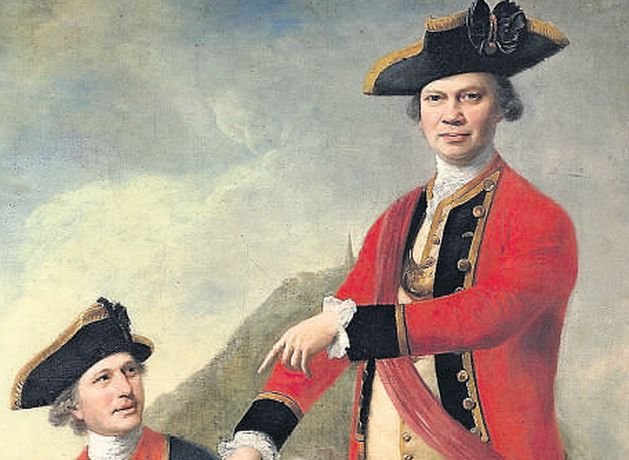
Christie’s has held an annual sale dedicated to Irish art since 1996, and has established world-record prices at auction for a number of leading artists including George Barret, Gerard Dillon, Jack Yeats, Paul Henry, Sir John Lavery and Thomas Roberts. The top lot in Thursday evening’s sale was a work by Nathaniel Hone, a double portrait of Lieutenant-General the Hon Philip Sherard and Captain William Tiffin at the Battle of Brücke-Mühl, which realised £294,500 (€373,790). The work was purchased by an anonymous buyer whose final bid set a new auction record for the artist.
Claire Bailey-Coombs, head of the sale, remarked that a highlight for her was the return of a work by Harry Clarke to the National Museum via a private sale just before the auction.
“It was a really bustling sales room and we saw animated bidding, with many top lots going to private collectors. This shows the depth of demand, spanning three centuries from the 18th century to the contemporary. We were especially thrilled to have negotiated the private sale, prior to auction, of the exemplary Harry Clarke stained glass window Unhappy Judas to the National Museum of Ireland. This work is now returning home to Dublin, where it was created in 1913.”
Although the sale did not reach as high a total as Sotheby’s, the number of buys-in was much lower at 34 per cent. In common with their rivals was the predominance of non-Irish buyers scooping up the top lots, with a strong contingent of UK and European private and trade buyers.
London remains a critical barometer of the international demand for Irish artists, and this week’s sales shows that there is a growing global interest in the market. In such a traditionally insular art market, this trend is very reassuring for investors here, who now have their potential resale market and the liquidity it can bring expanding before their eyes.
A new report commissioned by specialist bank Investec this month reported that Ireland’s super-rich have enjoyed unprecedented wealth accumulation in recent years but their international peers may have been more adept at protecting their assets.
It suggests that Irish investors’ over-exposure to the property market and Irish equities has meant that Ireland’s wealthy have lost heavily over the last 15 months and are critically in need of greater diversification into alternative asset classes. The art market has consistently shown low and negative correlation with other financial markets, so it seems there has never been a better time to start collecting capital on your walls.
Dr Clare McAndrew is an art economist and global investment specialist. She is founder and director of research and consulting firm Arts Economics (artseconomics.com) and author of ‘The Art Economy: An Investor’s Guide to the Art Market’ (Liffey Press)