
Unlock the Editor’s Digest for free
Roula Khalaf, Editor of the FT, selects her favourite stories in this weekly newsletter.
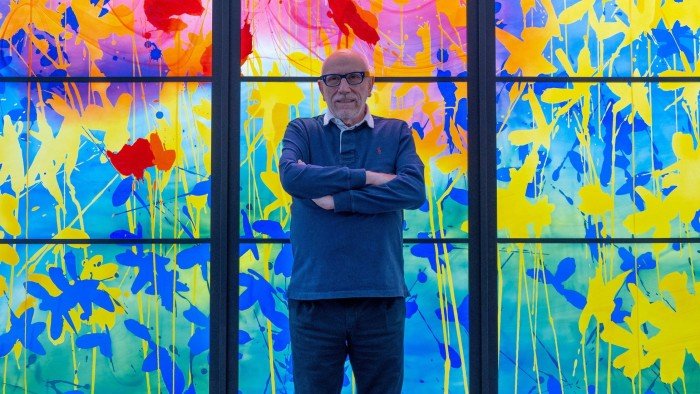
Brian Clarke, who died on July 1, the day before his 72nd birthday, dominated the world of stained glass from the 1970s onwards. Early commissions for churches mostly in his home county of Lancashire, using traditional glass and lead, might merely have made him the first among equals. But his embrace of abstraction, subtle symbolism and his fine sense of colour set him apart.
In 1977 his relationship with the Church of England ended and from the 1980s he designed but did not make windows, collaborating closely with the best glass studios in Europe and working internationally with architects of great distinction, including Will Alsop, Norman Foster, Future Systems, Zaha Hadid and Arata Isozaki. He never stopped painting, drawing or making collages, designing tapestry, mosaic and for the ballet. Two Cultures, a 1981 print series dedicated to his friendship with CP Snow, demonstrates the range of his interests.
Born in July 1953, Clarke grew up in an optimistically egalitarian postwar world, the son of a coal miner and a cotton mill worker. Aged nine, he stood before York Minster’s Great East Window, an unforgettable epiphany for a sensitive boy. One of the last recipients of a local authority junior scholarship, he attended art schools in Oldham and Burnley from 12. A prodigy, he absorbed contemporary art from newspaper colour supplements, filling sketchbooks with Pop-inspired collage and fluent life drawings. In 1970, he joined the architectural stained glass course at North Devon School of Art and Design.
In 1972 Clarke married the multimedia artist Liz Finch, a fellow student at Burnley, whose clergyman father encouraged Clarke’s embrace of stained glass (they had one son, divorced then remarried). A grant enabled visits to Italy, France and west Germany, where he took in the daring postwar abstract glass of Johannes Schreiter.

By the end of the decade, he was embracing London’s punk scene. The fashionable dealer Robert Fraser took him on and Clarke’s edgy charm and innocent enthusiasm resulted in friendships with David Bailey, Mick Jagger and Paul and Linda McCartney, the latter a particular soul mate — they co-designed the cover for Paul’s solo album Tug of War. More fatefully, he was a drinking companion to Francis Bacon and his lover John Edwards. But creativity always triumphed despite late nights and wild company.
Clarke’s firebrand manifesto “Towards a new constructivism”, published in his 1979 book Architectural Stained Glass, hailed punk rock as a fresh start for all the arts. By the 80s, he was working on an immense scale, using orchestrated grids of colour disrupted by floating organic motifs to glaze the Cavendish Arcade at Buxton Thermal Baths and the over 120-metre-long canopy for Leeds’ Victoria Quarter. His design for the deep-blue cladding for Will Alsop’s Hôtel du Département des Bouches-du-Rhône, Marseille (1994), earned it the sobriquet “Le Grand Bleu”.
He bonded with Norman Foster over the music of Kraftwerk, but their ambitious collaboration at Stansted airport was largely mothballed. Clarke nonetheless credited Foster with pushing him towards technical innovation on an unprecedented scale, using laminated layers of float glass sometimes combined with handblown glass, digitally etched and with coloured ceramic glazing. During the 1990s he worked with Foster on the largest stained-glass installation ever produced, for the five-storey lobby of Riyadh’s Al Faisaliah Centre. Clarke recalled he was liberated from puritanical abstraction by the client demanding images of camels, falcons and other local flora and fauna — even a desalination plant.
He went on to embrace vertiginous cinematic effects, not least in Foster’s Pyramid of Peace at Astana in Kazakhstan. The apex is entirely glass, the yellow and green of the national flag overlaid with scaled-up fluttering doves. His memorial is another coup de théâtre — “Concordia” at Bahrain International Airport, unveiled in April this year. He described it as “a great diaphanous curtain”, the screen bringing together Islamic pattern, oak leaves, dragon flies, hawks and swaths of opalescent jasmine. Aware of his mortality, Clarke imbued this last major work with optimism, jokily hopeful of a commission in the Celestial City.
A knighthood in 2024 honoured not just Clarke’s architectural glass but also valiant work for the Francis Bacon Estate in collaboration with Martin Harrison. An exhibition at Damien Hirst’s Newport Street Gallery marked his 70th birthday. But as pre-eminent artist in a genre barely recognised by the art world, there seems no obvious heir to his ambitious genius.