
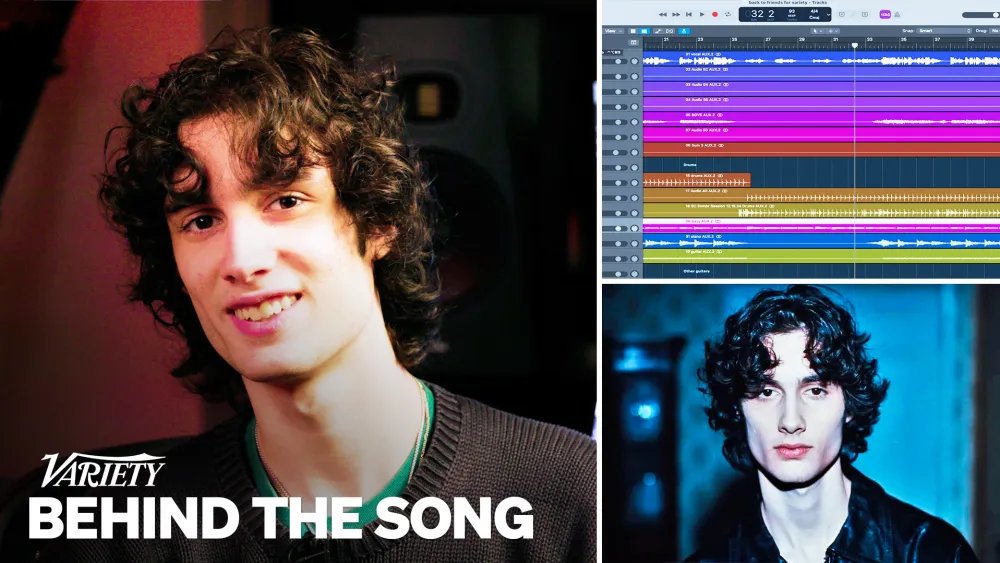
When Sombr thinks back to the moment everything changed, it still feels surreal. Before the Grammy nomination, before the packed shows, and before “Back to Friends,” he was just another teenager making music alone in his bedroom. One of those songs, “Caroline,” produced entirely on his own in his parents’ house, would become the moment that set the rest of his career in motion.
“I went to bed just a normal high school kid and I wake up the next day, it’s viral. Literally the next day,” Sombr told Variety in an episode of Behind the Song presented by TikTok. “Every record label is in my inbox.” Months earlier, he had been sending songs to labels with no responses at all. When he told his father what was happening, “he was like, ‘I don’t believe you.’” But it was real. Within days Sombr was on a plane to Los Angeles signing his first record deal.
The two and a half years that followed were steady; he built a small, loyal fanbase while searching for the song that would take him to the next level. “I had a small, consistent audience, but nothing was doing enough to recoup a record deal or make this career long-term,” he explained. “I kind of needed this and [I’m] really grateful that it happened when it happened.”
His song “Back to Friends” introduced a wider audience to his sound and earned him new industry attention, including a Grammy nomination for Best New Artist. For Sombr, the song reflects a personal struggle: the tension of trying to maintain normalcy with someone he once shared deep intimacy with, while realizing he can’t simply act as if the past didn’t happen. “I think it’s a universal topic, but I think with the chorus, I found a unique way of saying it,” he said.
What sets “Back to Friends” apart is how thoroughly he shaped the record himself. Sombr is the sole producer on the track and constructed it piece by piece, starting not with chords or lyrics but with rhythm. “When I start with a drum groove, I can set a vibe rather than set a chord progression,” he explained. Using a programmed loop in Addictive Drums, he built the song’s foundation and let inspiration spiral outward from there.
He added piano bass notes on his Yamaha upright, then built layers of background vocals by stacking simple “oohs” and harmonies. “Hearing one of them alone sounds so shit, but then when they’re all together, they sound so great,” he chuckled.
Vocally, he contrasts distortion-heavy verses with fuller, cleaner choruses. “It’s like yin and yang,” he explained. He prefers the verse vocal to feel strained, as though it’s pushing to break through: “I want it to sound so emotional, but the distortion is kind of like the vocals trying to cut through and escape.”
As the song builds, he brings in new elements to keep it evolving, adding a live drum kit in the second verse and weaving in more guitars and production flourishes. Near the end of the track, he created what he described as a “fake orchestra” made from layered vocals, piano, and synths. The song closes on a fade-out, a deliberate stylistic choice he thinks is due for a comeback. “I want to bring back fade outs,” he said. “I just want to give the listener a second to think about what they just heard.”
Looking back, Sombr says he slept through the livestream announcing his Grammy nomination and woke up to a flood of messages. At the time he wrote the songs that eventually put him in the conversation, he was still playing modest club shows. “I was playing 200-cap clubs that weren’t selling out,” he said, a reality that made the idea of a Grammy nod feel improbable enough for him to wonder, “Why am I even expecting that to happen?”
But it did. And for an artist who started alone in his bedroom, “Back to Friends” is both a reminder of where he came from and a sign of where he’s headed.
Watch Sombr’s episode of Variety’s Behind the Song above.