
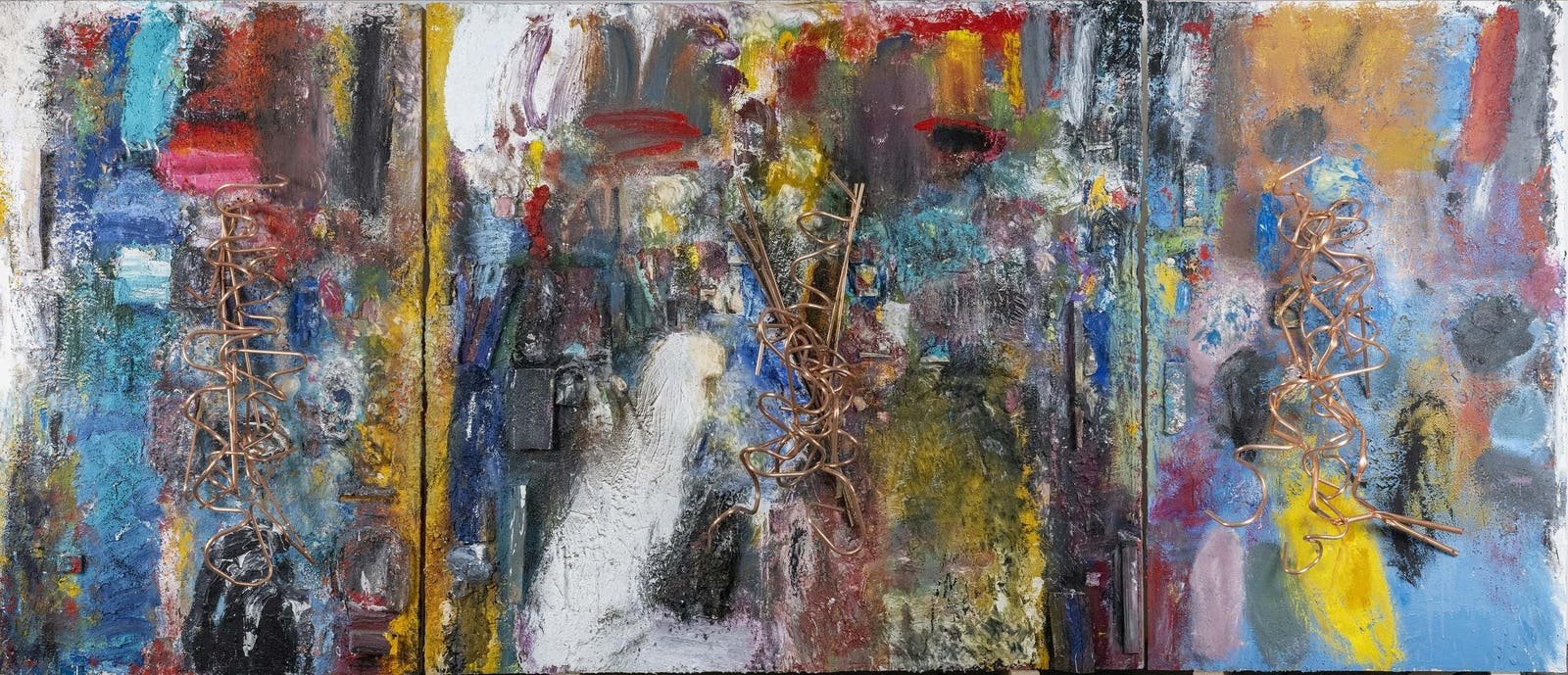
Jim Dine, Grace and Beauty, 2022, mixed media on canvas, 99 × 232 × 27 in.
Photo courtesy of Templon, Paris – Brussels
For the past 70 years, Jim Dine has remained one of the most singular voices in contemporary art with a practice that spans painting, drawing, printmaking, sculpture and poetry. Often associated with Pop Art yet never confined by labels, the Cincinnati-born American artist has remained defiantly personal, turning childhood memories, mythic figures and humble hand tools into recurring motifs of extraordinary power. Hearts, bathrobes, skulls, hammers, wrenches, Pinocchio and self-portraits constantly reappear throughout his practice, each revisited with new intensity and meaning over time. In this candid conversation, he reflects on the deeply personal narratives behind his works, his lifelong attraction to tools and the restless energy that still propels him to create.
Your paintings often incorporate tubes. What draws you to that fusion?
The tubes were always going to be there. I’m enjoying using the tubes like drawing.
Why do tools appear so often in your work?
It’s not a question of importance—it’s just what I do. I always feel hand tools are very beautiful, and sometimes I like to celebrate them.
Was that fascination shaped by your grandparents’ hardware store?
You could say that, but I’m a visual person. As soon as I became aware of tools—anybody’s tools—I was interested in the form, that this object existed. From that came use, work and a kind of beauty. It’s as good as anything. It’s like red paint, you know.
Where do you find the tools you use?
From the tool store, anywhere. If you live in a city, you can always go out and pick one up.
You’ve worked across so many mediums: painting, printmaking, sculpture. Do you approach them differently?
No, not really. It’s all the same energy. Whether it’s paint or bronze, I’m making decisions as I go along. I respond to what’s in front of me, and then I make the next move. That’s how it always works.
You sometimes manufacture your sculptures in St. Gallen, Switzerland. Why do you choose to work there?
The foundry is a very precise place with wonderful artisans who can execute what you want. That’s all you do there—make sculpture. Nothing distracts you. It’s a nice town, but it’s the artisans that count. They can execute what I want.
Jim Dine, The Blue Flame, 2022, polychrome bronze, 88 5/8 × 30 6/8 × 46 1/2 in.
Photo courtesy of Templon, Paris – Brussels
Some of the bronze sculptures are painted in vibrant colors. How do you decide on the palette?
It depends on what’s nearby. Is it red, is it yellow? I start from there and then make what I consider appropriate decisions.
You seem very hands-on in every stage of the process.
Yes, if it’s my sculpture, I feel I have the obligation to make it myself—not allow someone else to realize it.
Your Pinocchio works have become emblematic in your career. Where did that fascination begin?
It wasn’t a story for me; it was an image. My mother took me to see Walt Disney’s Pinocchio when I was a little boy in 1940, and it stayed with me. Because it is a metaphor for creation, I felt it was a profound story. I continued it—sculpturally, in prints, in drawings. It became a motif that was mine. I’m not interested in it right now, but I might be again eventually.
At one point you imagined yourself as Pinocchio, and later more as Geppetto. What changed?
That’s true. Each time you make an artwork, you’re giving birth to something.
In one of your paintings, I thought I saw a skull. What story were you trying to tell with that painting?
It’s not a skull; it’s teeth. There’s no face, just teeth. It’s about the teeth of someone I knew—the story of his teeth.
Can you describe your creative process for this painting?
I didn’t start with the idea of teeth. I started with the idea of making a painting, so I started to paint. At one point I felt I needed something, so I put in color. Then I thought I needed some teeth, so I put them in.
You’ve been creating art for seven decades. What keeps you going—where does the energy come from?
From luck—genetic luck. I’m fortunate that I’m still able to work right now. I also get energy because I love to work, and I’m challenged by the projects: making a better painting, a better sculpture, pushing it further. That’s where it comes from. At some point, I won’t have it anymore, so I’m trying to take advantage of it while I do.