
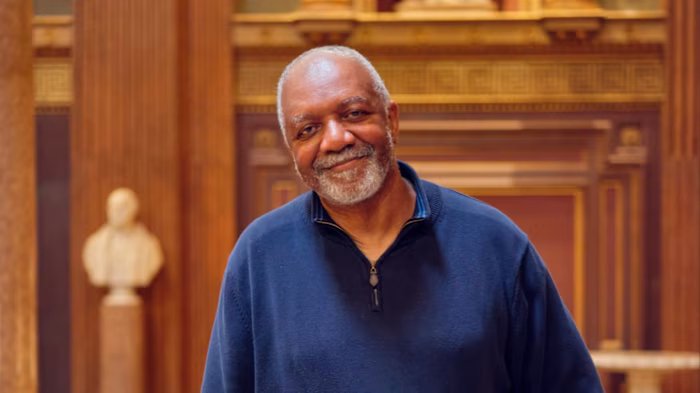
In a wood-panelled library of the Fitzwilliam Museum in Cambridge, the artist Kerry James Marshall is reminiscing about his first encounter with art. “Two things impressed me,” he says of a school trip to the Los Angeles County Museum of Art: a pair of 10ft-tall paintings by Veronese, “with monumental figures that looked like superheroes”, and an African sculpture a fraction of the size that exerted its own spell. “It was the first time I’d been in a museum and I was struck by the power of both: the gigantic and heroic; and the small and mysterious.” Ever since, he says with wonder still in his voice, “I’ve been trying to match that power”.
Marshall, who turns 68 this month, is among the greatest living painters, known mainly for epic figurative works, though his practice extends to drawing, photography, sculpture and video. In the early 1990s, the LA museum he frequented as a child was the first of many — including MoMA in New York — to acquire his paintings, and he was elected an honorary Royal Academician in London last year.
Last month, two stained-glass windows he designed for Washington National Cathedral displaced those honouring two Confederate generals. The artist, whose paintings can fetch more than $20mn, charged a symbolic $18.65 for the commission — referencing the year the US civil war ended and all enslaved people were freed.

He is in the UK to unveil his first formal portrait painting (other than self-portraits) of a living subject, “Henry Louis Gates Jr” (2020), which he has donated to Cambridge university. The acrylic painting is of his friend the scholar “Skip” Gates, director of the Hutchins Center for African and African American Research at Harvard University.
Gates, the first African-American person to win a Paul Mellon Fellowship to Cambridge 50 years ago, says he approached Marshall, whom he has known since 1985, for a portrait to replace a black-and-white photograph in Clare College. But the finished work’s eminence destined it for public view. The Fitzwilliam’s director, Luke Syson, sees it as an “unexpected masterpiece” reminiscent of Holbein’s portraits of Erasmus or Thomas More. The work is now on show, beside a Seurat painting, outside the museum’s landmark exhibition Black Atlantic.
While it is a departure from painting based on his imagination, the new work renews Marshall’s life-long dialogue with western art. Portraiture, he says, is “very specific. It’s meant to illuminate the sitter, not the artist, so you have the obligation to represent that person as faithfully as you can. That puts you under pressure to get the likeness right. I take the responsibility seriously.”
Yet, the painting “as an object is important to me as well — how the subject is locked into an arrangement of other shapes”. Among portraitists he admires are Rogier van der Weyden and early Flemish painters, who created “some of the most beautiful portraits ever made by anybody” — even though he has no idea who the subjects are. “That’s how I wanted this to be: not just of a person, but to build a picture around them.”

A seated Gates, in habitual Savile Row suit, frowns contemplatively beside a table with some of his books, one of his Emmy awards and an African sculpture, trees visible through the windows behind. Gates did not sit for the painting, but for pictures taken on a phone during a visit to Marshall’s studio in Chicago. “I was trying to find a moment when the way he looked gave me an idea for the kind of picture I’d want to make,” Marshall says, “an aspect in his face that captured who I thought he was.”
He had visited the professor’s house in Cambridge, Massachusetts, where the portrait is set, but at night-time. “Everything outside is made up, even the architecture. I asked him about his favourite place — a dining room in front of windows — and constructed a setting.”
The volumes include The Signifying Monkey and Thirteen Ways of Looking at a Black Man, which Marshall sees as a “small but important book of profiles”. The sitter’s desire to include his latest book threw a spanner into the composition. “I’m using a formalist mathematical system to organise pictures,” Marshall says, recalling his exasperation. “I have to find place in it.” The final volume appears vertically, to one side.
Though these books are in the artist’s own library, he declines to see them as an influence. “I was already on that trajectory on my own,” he laughs. With his warmth, precision and gravitas, Marshall emanates an unshakeable sense of having chosen his own path, fuelled by voracious study, self-reliance and a slow-burn sense of injustice.
Born in Birmingham, Alabama, he moved to Los Angeles with his family not long before the Watts riots of 1965, a spell of civil unrest after police brutality against a black man. At nearly 10, he knew they “made no sense; it was chaos”. In the turmoil of the civil rights movement and campus sit-ins, he was “never a joiner, a follower”.

One demand at school was that black history be taught. “The problem I had with their dissatisfaction was there was nobody in the public library,” he says. “I could read anything I wanted. There were art books . . . Goya, Fragonard, Rembrandt — things I admired. Nobody was taking them out.” It was a lesson in “how one sees oneself in the world — as someone to whom things are done or as someone who goes out and does things . . . I act as a free agent. Nobody was stopping me.” Marshall graduated from the Otis Art Institute in LA in 1978.
Perhaps most striking about the new portrait is the mimetic complexion, a departure from the emblematic blackness that is perhaps his greatest formal innovation. “With Skip, I’m going to match his complexion as closely as I can,” he says. “I’m not using it rhetorically to make a statement about the presence of blackness.”
Marshall explains his project: “Are ‘black people’ black? In reality, the range of skin tones goes from dark-dark to caramel and light brown and, because of the ‘one-drop rule’, to white. That’s the reality, but the rhetorical position is, we’re black people. So you make that concrete, which is what I did.”
At the same time, he gave “blackness a chromatic complexity, by beginning with Mars black, ivory black, carbon black — three pigments you can buy off the shelf. Then I’ll add cobalt blue, or chromium-oxide green, to paint my figures. They can look really black,” but the differences are only apparent, he says, “to people willing to look closely”.

The problem, he says, has never been the total absence of black subjects in museums, but “quality — that’s different.” Marshall’s ambition has been to make work whose presence would compete. “When I was growing up, I didn’t see a painting [of black figures] 20ft by 15ft,” he says. “That’s what makes a difference to me, because power is amplified by scale. That’s the challenge I was trying to address.”
Does he see art as activism? “I don’t have any illusions about the transformative power of art. Pictures don’t do anything. People do things. You can make pictures that anger, upset, inspire. But they’re not a catalyst.” While activism, he deadpans, “requires almost no thinking”, paintings “require you to think”.
Find out about our latest stories first — follow @ftweekend