
LONDON — “No sooner blown, but blasted.” I am standing on a landing outside a locked gray bedroom door when this phrase swims into my head. It is from a poem written by the English poet John Milton between 1625 and 1626, and it is about a primrose, a flower of spring.
Behind the locked door are two flower paintings that I came here to see. Shaking me out of my reverie is Rebecca, the museum’s marketing and communications manager, who unlocks the door. Fittingly, she is wearing a floral print dress. “Welcome to the Red Bedroom,” she says. “All the rooms have names.” It feels a little like a scene from Alice Through the Looking Glass.
Milton’s youthful poem is tragic and elegiac. It is called “On the Death of a Fair Infant Dying of a Cough.” The child’s untimely death at eight years old was likened by the poet to the passing of a flower — how quickly its beauty fades! Of such is human life.
We are inside the Red Bedroom now, and it is fairly dark. Rebecca opens the gray wooden shutters a little, but not too much. Like flowers, flower paintings are sensitive to the light.

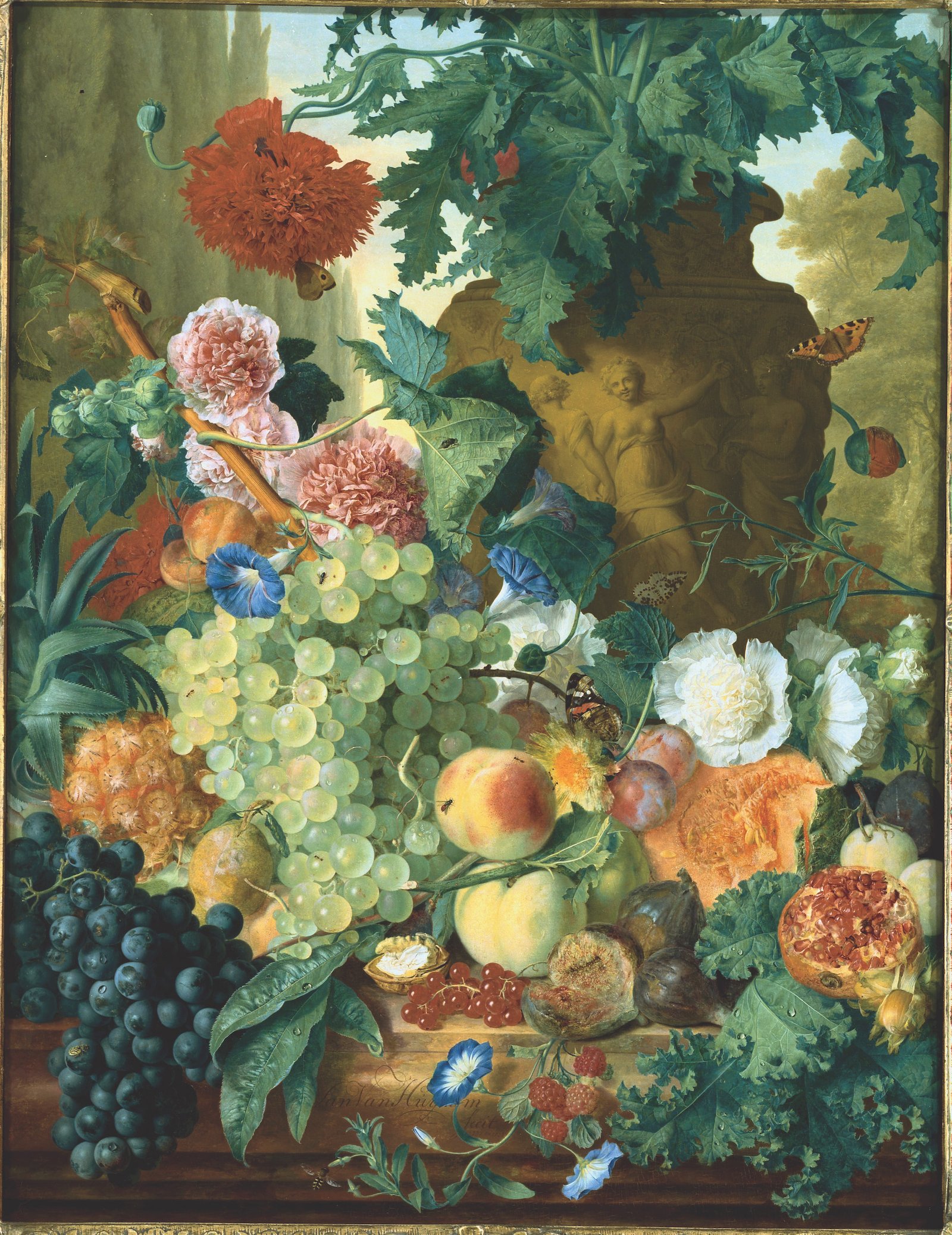
There are just two flower paintings, hanging side by side on a wall that faces that window behind me. They were made by a Dutch artist called Jan van Huysum in the 1730s, long after the so-called Dutch Golden Age of art. In various respects, they are radically different from many paintings of flowers that came before and after. One of them is predominantly a depiction of flowers; the other offers up to the eye — yes, it does look like a gorgeous tendering — an abundance of fruits and vegetables, with flowers attendant. Both have insects busying around too. These fruits and flowers — some very exotic indeed — are objects at which to marvel: See this pineapple!
Van Huysum flourished in the European Enlightenment, which was characterized by a new belief in rationalism, and the powers of the new sciences to observe and describe the world. You could call his flowers hyperrealistic in their attention to detail, in their painstaking fidelity to what he is looking at. As if acknowledging that fact, keys to the two paintings are on the wall behind me. Every flower, every insect, every fruit is listed and named.

The door of the Red Bedroom in which the paintings hang, like so many doors in this house, is fashioned in the gothic style, coming to a point at the top. Why? Because this is Strawberry Hill House, the mock-gothic fantasy close to the banks of the Thames at Twickenham, created by Horace Walpole — author of The Castle of Otranto, the very first gothic novel — in the 1740s, soon after van Huysum made his paintings.
Horace’s father, Sir Robert Walpole, England’s first prime minister, and a great collector of art, was very keen on van Huysum’s paintings. He even bought a couple. Regrettably, he sold them off to Catherine the Great of Russia in 1779, together with much else of his impressive collection of paintings. Catherine, in turn, gave him a portrait of herself. The sale caused absolute outrage in parliament. It was described as an act of betrayal.
I say this to emphasize the fact that a mere — mere! — flower painting could be so valuable. Van Huysum’s works were eagerly sought after by kings, emperors, and unpleasant toffs of almost every conceivable stripe. He was a huge success, financially. When the painter Benjamin West came to evaluate Walpole’s paintings prior to their sale, the van Huysums were worth exactly double what a Rembrandt would fetch.

The world in which van Huysum painted his flowers — very slowly, accumulating each one over months or even years, as different flora emerged season by season — was an increasingly secular one. You may notice that when you look at the artworks. They are not overshadowed or haunted by morality or religion, as Milton’s words had been. They are not symbols, as the white lily tendered by the angel of the Annunciation to Mary, weighty with local politics (the lily was the symbol of Florence) and Catholicism, had been.
These are not paintings of flowers in all their transience, but flowers of the curious Now, flowers for the age of the great taxonomist Linnaeus, in all their splendid, bullish brilliance. Nor are they flowers to move the heart. They are painted crisply and dispassionately. They evoke a telling phrase that haunts the epitaph of W.B. Yeats: “Cast a cold eye. On life, on death. Horseman, pass by!”
Things were to change again in the succeeding centuries. When van Gogh paints a lolling flower in a vase, it is also more than a glancing (and sighing) contribution to his tragic autobiography. When Monet painted his great waterlily sequence on permanent display at the Orangerie in Paris, he could barely see. Scientific fidelity was nothing to him. It was the heart, the heart that was pulsing.
Two Masterpieces by Jan van Huysum continues at Strawberry Hill House & Garden (268 Waldegrave Road, Twickenham, London, England) through September 8. The exhibition was curated by Silvia Davoli.