
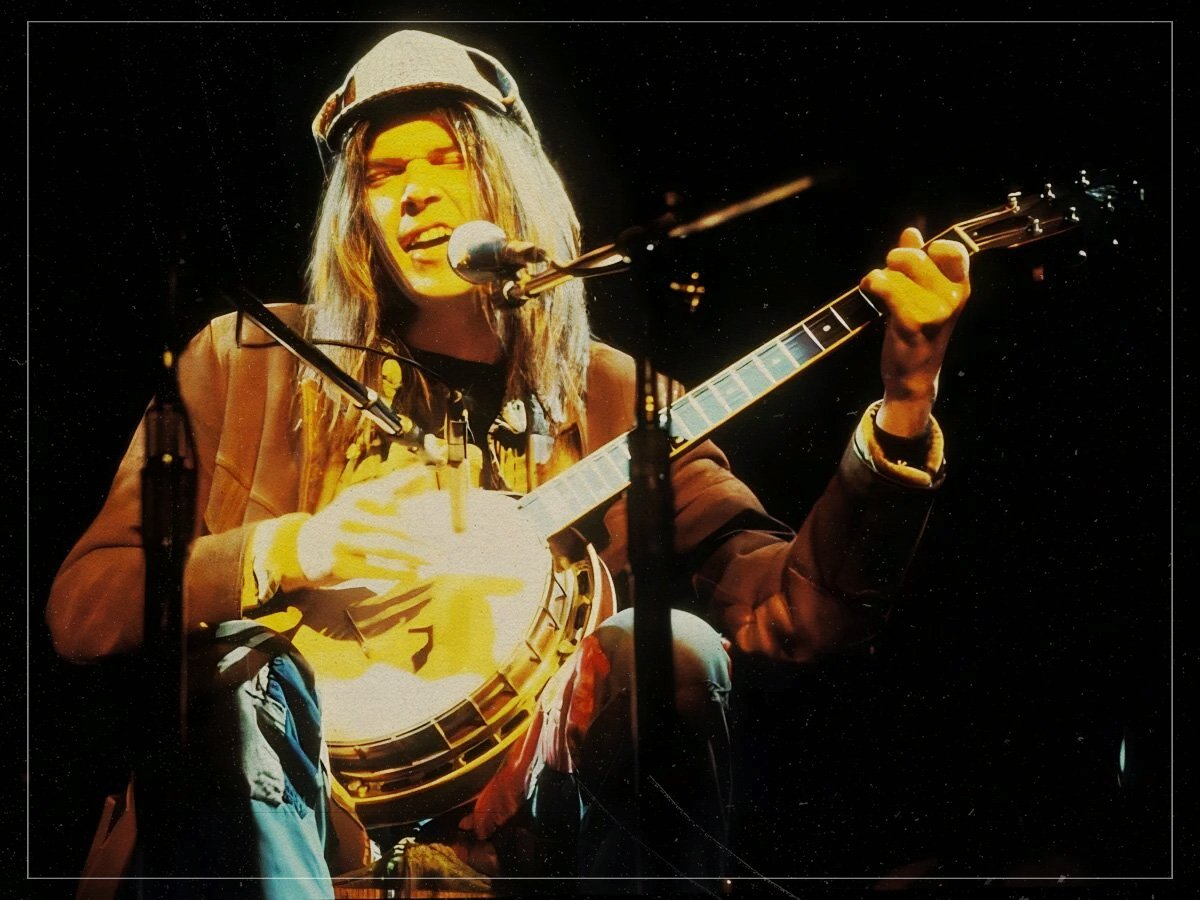

(Credits: Far Out / Alamy)
Neil Young has never apologised for being a student of rock and roll. Since his earliest days, he has seen fit to take everything from the glory days of Elvis Presley and Chuck Berry and channel them through the poetry of Bob Dylan. But, really, what is the definition of rock and roll?
Because as much as people know a great rockstar when they see one, there’s always been a subjective definition of what rock was supposed to be. Sometimes the archetype is The Beatles, other consider it to be Led Zeppelin, and even in the modern sense, it’s hard to think of a better definition for a rock band than what Nirvana did. But in the context of rock and roll, Young seems to fit right in the middle of all of those.
He had the ramshackle approach to hooks the same way Kurt Cobain did decades before he had even started, and even when working on his prettier records like Harvest, he had the same kind of singer-songwriter mentality that went into some of the best Beatles songs. And yet, he always seemed to be a one-off in the music industry. No one else was doing what he could, but did we really need another one of him?
Young had consistently been a thorn in the side of the industry in the minds of suits, but you could never say that he ever got boring to watch. Part of the appeal was the chaotic nature of him switching up his styles every time he made a record. There would be country music, folk music, and music that didn’t seem to have a clear origin like anything off of Landing on Water, but if there was one genre that Young always thrived in, it was the chaotic side of rock and roll.
Rust Never Sleeps might have had some of the raucous energy of his live shows with Crazy Horse, but the true nature of Young’s music was hearing it live. It was about capturing that same energy he felt whenever he put on his favourite records, and when it came time for him to study his biggest inspirations, there was no greater template for rock and roll than Little Richard’s primal scream.
While everyone from Chuck Berry to the earliest blues artists like Muddy Waters could claim to embody the spirit of rock and roll, Young felt Richard towered above them all, saying, “He is great, he is still a madman, he is completely outrageous, Little Richard is Rock and Roll. If I could play it myself (one of his songs in a show it would be) ‘Send Me Some Loving’, that’s a great song.”
And while it’s hard to say that Richard was the most eclectic of all time, given how similar some of his tunes sounded, it was always a thrill hearing him sing nearly anything. Everything from ‘Keep A-Knockin’ to ‘Kansas City’ to ‘Good Golly Miss Molly’ all had near-identical chord progressions, but even if you didn’t see him throw his leg up on top of his piano, it was worth it listening to him at home and hearing him shred his larynx to bits for the better part of two minutes.
Some of the more sophisticated music fans may have only heard cacophony, but Young knew a new avenue was being made for people like him. Because if there was one thing to take from Richard, it was that you didn’t need to have the most tasteful voice in the world. It was simply about having the passion for music and being able to translate that to every person within earshot.
Related Topics