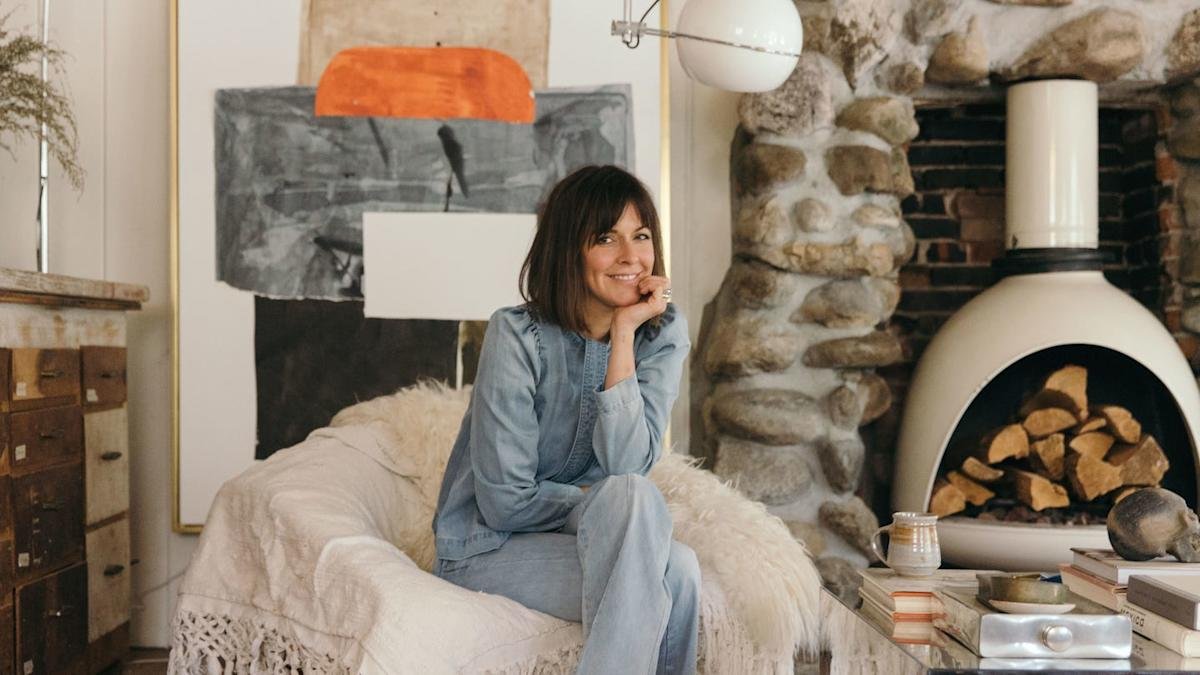
An Insiders’ Guide to Art CollectingCourtesy of Leanne Ford
“Hearst Magazines and Yahoo may earn commission or revenue on some items through these links.”
Hearst Owned
Hi friends—Leanne Ford here. For the first time ever, my little art magazine FEEL FREE is online, and I’m thrilled to share it with you through this first‑of‑its‑kind content capsule with House Beautiful. Think of this as your invitation to play, to get inspired, and to try something new in your own home—because around here, it’s all about freedom of expression and freedom from perfection.
—Xx, Leanne
As a designer curating my own art collection, I usually buy what I love first and figure out the rest later. But when it comes to investing in art, is that even a good plan? Where does one start? What makes art collectible—and what makes it tick? And as far as the market goes, how does a scribble become the next Picasso? I asked three of my favorite art world insiders to help make sense of it all.
Courtesy Freja Harrell
Freja Harrell On Finding Synergy Between Art and Interiors
About the Expert: Freja Harrell joined Gagosian New York in 2011, working directly with collectors, developing exhibitions, and managing a number of the gallery’s artists.
I met Freja and her husband while sitting at the bar of il Buco for dinner one night, and the four of us chatted for hours. She’s been such a friend and advisor ever since, even forgiving me when I saw this small ceramic piece sitting in Gagosian and asked (in front of her co-workers, mind you), “Can I touch it?” (NO.)
I am fascinated by gallery life, and I told her I would show her the downtown art world scene if she would show me the uptown art world scene. Both are magical—though something tells me she needs zero introductions to anything happening in the arts. I am an art lover through and through, but Freja’s world of art is fully on another planet—for every reason. Freja has shown me pieces that have truly made my heart skip a beat just to be in the room. I love having her perspective in my art life, and now I get to share it.
Leane Ford: I usually buy what I love, but is that even a good plan when it comes to investing in art? Where does one start?
Freja Harrell: Yes—if you love it, you’re already halfway there. But if you’re spending enough that it feels reckless not to consider long-term financial value, look at the bigger picture, too: What else has the artist done? Where does their work fit into a broader art historical context? Is it derivative or does it have its own legs? Is there a market for the work? Is there curatorial backing? This takes time and diligence, and if you’re serious about building a collection with long-term weight, you probably want to consider enlisting a professional [art consultant].
LF: Where does the decorating end and the investing begin? Where do they overlap?
FH: I’m biased since art is always the star in my line of work, but to me, decorating focuses on aesthetic cohesion, which most of the time is not the point when connecting with art. I totally understand wanting to avoid a fistfight between the art and the interiors, but I think if you’re staying true to your sensibilities, some natural harmony will happen. I also think the most interesting rooms happen when the art isn’t chosen to match the sofa, but because it compels you for other reasons.
LF: What makes art collectible? What makes it “tick” for you?
FH: There’s something called Stendhal Syndrome, which is an actual psychosomatic reaction, like chills or dizziness or palpitations, brought on by exposure to great art. It was coined in Florence, where people kept fainting in front of the Botticellis and Michelangelos. Most of what you see is not going to elicit that. But when something stops you in your tracks, makes your heart skip a beat, lingers in your mind—that’s staying power. Buy that.
LF: As far as the public and market go, what turns a scribble into the next Picasso?
FH: The market is a fickle place, and a lot of what it chases turns out to be a flash in the pan. Art that lasts tends to have critical and curatorial consensus behind it. But a lack of that isn’t a verdict on an artist’s importance; it’s often just timing, luck, and a dozen other variables that have nothing to do with talent
LF: So, how can you tell if a piece will hold or grow in value over time?
FH: You can’t—and anyone who tells you otherwise is selling you something. But what you can do is stack the odds; know the artist’s trajectory, understand their work, see how it fits into the larger ecosystem.
LF: How do you go about advising others?
FH: If they’re just starting out, I want to begin by understanding what they’re drawn to and help them find that lodestar that can inform their collecting and serve as a throughline. People tend to get caught up in palettes, or “isms”; I think if you focus on the underlying current, you’ll build a collection that’s far more dynamic and far less predictable.
LF: For someone just starting to collect fine art, what’s a smart and small first step?
FH: See as much art as you can. Visit museums, fairs, galleries, biennials—travel for it. Talk to people who live and breathe it. Eventually, you’ll begin to see the difference between something derivative and something singular. Don’t chase the market—understand it. Figure out what you’re drawn to and, more importantly, why. Putting words to it is a productive way to tease out a throughline for your collection. Talk to gallerists and visit artist studios; contemporary art is a living thing, and it’s deeply gratifying to build relationships with those who make it and steward it.
Courtesy of Andrew Brentan
Andrew Brentan and Danni Simon on Embracing Authenticity—and Risking Chaos
About the Experts: In 2022, alongside Danni Simon, Andrew Brentan founded Field Trip Art Advisory, a boutique consultancy curating fresh, intentional, and authentic art collections.
Andrew and I went to college together. I didn’t know of him as a taste maker just yet (none of us were…) or that he even had an interest in art. But I did know him as a great guy and a good time. I was so thrilled to hear of his new venture a few years ago through mutual Ohio University friends. I love what he’s doing, and I love how attainable it can be for all of us.
Leane Ford: Where does one start investing in art?
Danni Simon: For most of our clients, art-as-an-investment is a secondary consideration. Buying art that you want to live with is everything! That’s exactly where we advise people to start. Determine what you love by looking at a lot of art. Art galleries are tiny free museums. Instagram and Etsy can take you down weird and wonderful rabbit holes. Explore everything and find what lights you up. Even when the goal is a financial investment, we still want our clients to love their art. So when our clients are interested in appreciation and resale value, we start with their personal taste and then—only then—look at artists with more established careers or emerging artists with an interesting career trajectory and markers that their work might become more valuable with time. Ultimately, if you buy what you’re personally drawn to, what you want to live with, and what makes your heart happy, you will always have a collection that’s worth the investment.
LF: What drew you to art in the first place, and how does that influence the way you collect yourself?
DS: I’m drawn to story—the artistic process, the relationships with artists, the stories in the pieces themselves, things that make living in this wild world feel more shared, more communal. Art helps me make sense of being human. I’m also a very aesthetic person and process the world visually. So my environment helps set the tone for the life I want to step into. I collect art that reminds me to be who I want to become.
LF: How do you go about advising others?
DS: Start thinking of art for your home more like music that you love. You don’t have to know anything about music to love a song. Don’t buy art because you hope your friends will think it’s cool. Don’t buy something just because your designer thinks it will look great with the finishes. Art is a way to embrace authenticity in your home, so ask yourself how you want to feel in your space. Do you want a soothing place to relax and reflect? A funky vibe that lets your quirks shine? Trust your instincts—and don’t be afraid to get weird.
LF: What’s your favorite piece of art in your home and why?
DS: We have a painting called A Rare and Delicate Flower by our friend, Johnny Defeo, who paints incredible landscapes. He uses the best colors and includes an element of funk that is so charming. The piece transports me to a magical forest, and the light in our home changes the experience throughout the day. It reminds me of my small, unique place in this beautiful, mystifying world.
LF: If someone could only buy one piece of art this year—a style, a piece, or an artist—what would you tell them to look for?
DS: Buy a piece that you could look at for hours, days, months, years. A piece of art that is always opening itself to you, offering more tiny moments of discovery. For my money, this is the best kind of art investment.
LF: How do you know what medium is right for a space?
DS: Think about what the space already has and what may be missing. Is it eclectic and full of disparate components? A large, saturated oil painting could help ground the room, but a collage might tip the room towards chaos. Is the room stark and a little sterile? A textile could add warmth, or a photograph could bring light and life. That said, everything in moderation, including moderation. Sometimes, going all in—a blue wall with a blue painting, framed in blue—can feel deep, rich, moody, enveloping. It’s really about staying intentional with the space as a whole and how you want to feel when you’re living in that space.
LF: Do you start with the space or the piece when choosing art for a home?
DS: In my dream world? We start with the art and build out from there. I love to imagine how quirky a space could be if it were designed around an awesome painting. In my real world, we’re usually starting with a space that has some decided components (paint, furniture, rugs, etc.). So we look for art to bring everything together and help each choice in the room feel more organically collected over time, less decorated or contrived.
LF: Are there any mediums or styles you feel are having a “moment” right now?
DS: Art trends often ring a little false to me—a “blue is the new black” kind of vibe. We are seeing from our clients (much to our delight) a renewed craving for the analog, wanting the texture of paint, beautiful imperfections, details that take time, thought, and experience. We have a new piece from Sayde Anderson, who creates textile pieces using only dyes created from flowers she grows on the farm. She’s currently working on a deep-red dye grown from Madder root that won’t be ready to harvest for three years. To me, that kind of craftsmanship is timeless.
LF: Are there any mediums or styles that you feel are truly timeless?
DS: Any time you can see the presence of the creator in a piece—a brushstroke in a painting, a fingerprint in a ceramic, the perspective of time and place that a photo lends—this is all timeless for me. Letting the raw humanity of making something show through.
LF: What’s your advice for mixing different mediums in one home without it feeling chaotic?
DS: Please do it! Varying the mediums will make your art collection feel unique, thoughtful, and reflective of your individuality. If that feels wide open and a bit intimidating, ground your collection in a color palette that repeats throughout. Always remember that you likely cannot see your bedroom and living room at the same time, and no one else can either. There’s no need to be too careful or get too precious.
LF: What do you want people to know when they’re getting started?
DS: Start following the artists you’re drawn to, even if their art feels out of reach, and see if something affordable pops up. We’re always on the lookout for when artists we love drop a limited edition print. Or we’ll spring for a tiny original piece; it’s amazing how much texture and vibe a little gem can add to a home. Lastly, invest in quality framing. Sometimes the framing costs more than the art, and that’s okay. Good framing will make your art look smart and considered.
Courtesy Eneby Home
Doug Jenkins on Trusting Your Intuition
About the Expert: Doug Jenkins and his wife Carina started Eneby Home 19 years ago, beginning in Scandinavia. Today, they import an average of 9 to 10 containers a year from all over Europe and operate a 10,000-square-foot showroom and a 5,000-square-foot warehouse in Nashville, Tennessee.
Doug and Carina have cost me a pretty penny in my life of design; I don’t think there’s a single thing they sell that I don’t want, including their art collection. I am lucky enough to have a few vintage pieces on my wall from them. Their attention to color, quality, subject, and materiality in all things is enviable. Their curation of vintage is failproof, and I have never regretted a single purchase.
Leane Ford: When it comes to investing in art, is buying what you love a good plan?
DJ: Definitely—you’ve got to love it first. For us, the investment part just happens naturally. Sure, we’d love a Picasso someday, but for now, we buy what speaks to us, which stems from many years of looking and learning.
LF: Where does decorating with art end and investing in art begin?
DJ: We primarily buy decorative art—mostly vintage 20th-century, but we can also buy 17th-century if it’s something we love and it fits our brand and inventory. Unless it’s by a listed artist, you just need a good sense of what the piece is worth
LF: What drew you to art in the first place, and how does that influence the way you collect yourself?
DJ: We stumbled into this business 19 years ago, starting with furniture, art, and decorative pieces. Travel has shaped our eye—we explore with an open mind, absorbing everything like a sponge. We love to mix styles, periods, and colors. It may be eclectic and a little all over the place, but to us, the mix is what makes it beautiful. Most of the art we buy is something we’d take home ourselves, but finding the right piece depends on the space and the budget.
LF: What’s your favorite piece of art in your home and why?
DJ: We have a 19th-century painting of a boy tending a fire that we found in France about eight years ago. At first glance, it’s quite dark, but when you look closely, you can just make out the side of his face illuminated by the flames. It’s realistic, and it tells a story.
LF: If someone could only buy one piece of art this year—a style, a piece, or an artist—what would you tell them to look for?
DJ: An easy jumping-off point is a landscape or still life. Large or small, they work in almost any style of home and are easy to live with.
LF: What do you look for when sourcing art for your vintage shop?
DJ: Art that we like, and that we know we can sell—that’s the same rule we follow for everything we buy. All of our art comes from Europe.
LF: Do you have certain color palettes you gravitate toward—or avoid?
DJ: Nothing too bright; soft greens and blacks are always easy to place, and we love earthy tones that work with almost anything.
LF: When you find a vintage piece, how do you determine if it’s a true gem versus just a pretty object?
DJ: Intuition, mostly. We’ve been doing this long enough to know when something feels special. Of course, what we’re willing to pay is part of the equation, too.
LF: Are there any periods, mediums, styles, or subjects that always sell—or never sell?
DJ: Still lifes, landscapes, good abstracts, and nice portraits tend to do well for us. Of course, art is subjective, so in the end, we just buy what we like.
LF: What’s one vintage art “steal” or story that still makes you smile?
DJ: We once found a large stained glass window from a building in Bologna, Italy. We bought it for ourselves, hoping to one day put it in our future home—and five years later, we finally did. It’s not a painting, but it sure feels like one.