

[ad_1]
It was one of the less crowded shows in a frenetic October week that saw thousands of the world’s wealthiest flock to Paris for Art Basel’s first fully branded fair in the city.
Held in the bijou Musée Cognacq-Jay, devoted to French taste in the Rococo era, Pocket Luxury was an exhibition of around 290 exquisitely crafted snuff boxes, nécessaires and other small accessories that were integral to elite lifestyles in France in the 18th and early 19th centuries. A gold and enamel perfume spray bottle dating from around 1800 in the form of a miniature flintlock pistol was one of the most memorable of these precious objets.
A centuries-old scent dispenser may seem un- connected from what was going on at Art Basel Paris, but in a week when Sotheby’s showed off its new French headquarters, with the original Hermes Birkin handbag given pride of place, and François Pinault’s Bourse de Commerce and the Fondation Louis Vuitton held major exhibitions respectively devoted to Arte Povera and Tom Wesselmann, Paris, more than ever, felt like a city in which art and luxury are inextricably interlinked. That feeling will become even stronger at the end of next year when the Cartier Foundation for Contemporary Art opens its vast new exhibition space opposite the Louvre.
“The association between contemporary art and luxury lends brands a unique and distinctive identity,” says Sixtine de Saint Léger, co-curator of the Pocket Luxury show, referring to France’s great fashion houses, such as Louis Vuitton, Cartier and Yves Saint Laurent (owned by Pinault’s Kering group), as well as Prada in Italy. “In a world where competition is proliferating, and fashion and luxury are becoming increasingly popular, the major luxury brands are doing everything they can to preserve their image of excellence.”
Paris, with its world-class museums, galleries, restaurants, designer shopping—and now its own big-brand art fair—represents a compelling venue for an art trade increasingly reliant on an ultra-wealthy international clientele that lives what may be termed a ‘luxury lifestyle’. The venerable Fiac (Foire Internationale d’art contemporain, which Art Basel replaced in 2022) used to have a reputation for attracting a predominantly local francophone crowd. The new Art Basel Paris event has drawn names such as Queen Rania of Jordan, Wendi Murdoch and Sheikha Mayassa of Qatar, according to the organisers. One prominent New York-based exhibitor says he spotted Xi Mingze, the only child of Xi Jinping, China’s president, at the preview.
Who says no to a trip to Paris?
“Paris is a destination city uniquely suited at this moment for a grand international art fair,” says Marianne Boesky, a New York dealer who organised a pop-up gallery in the eighth arrondissement to coincide with the fair. “Paris is a magical place historically, architecturally, academically, gastronomically and creatively. Whoever says no to a trip to Paris?”
Crucially, Art Basel Paris also seems to be a fair where dealers are now capable of shifting big-ticket art. Hauser & Wirth says it sold a four-foot-wide Louise Bourgeois bronze Spider I (1995) sculpture to an “esteemed” private collection for $20m. The Paris-based branch of the Italian dealership Tornabuoni sold a rare 20ft-wide Alighiero Boetti Mappa hanging from 1991 to Casa Sanlorenzo, a private cultural foundation in Venice founded by the eponymous luxury yacht maker, for more than €10m. White Cube found a buyer for Insile, a large ink and acrylic on linen work from 2013 by Julie Mehretu, marked at $9.5m.
“I would view the convergence of Art Basel Paris, luxury shopping and high-end dining as a significant milestone in the evolving relationship between art and luxury,” says Daniel Langer, the chief executive of the consultancy firm Équité and professor of luxury strategy at Pepperdine University and New York University.
“This synergy is creating a powerful draw for affluent individuals globally, particularly from the US, Europe and China,” he adds. “The luxurification of the art world is a natural progression that aligns with the core values and strategies of luxury brands.”
In 2015, the Paris-based academics Nick Rees-Roberts and Silvano Mendes published the prescient article, New French Luxury: Art, Fashion and the Re-invention of a National Brand. The study contended that the language of luxury goods and art had converged. France’s great fashion brands have invested heavily in the art market to create a new “intersectional” definition of luxury.
“Amongst a number of brands with similar positioning, the link with art provides a cultural veneer and helps to justify high prices,” says Mendes, who teaches at Panthéon-Sorbonne University in Paris. “Art thus becomes almost a commodity like any other in the process of creating intangible value. This is perhaps the greatest change between the globalised luxury of the 21st century and that which was structured at the end of the 18th century.”
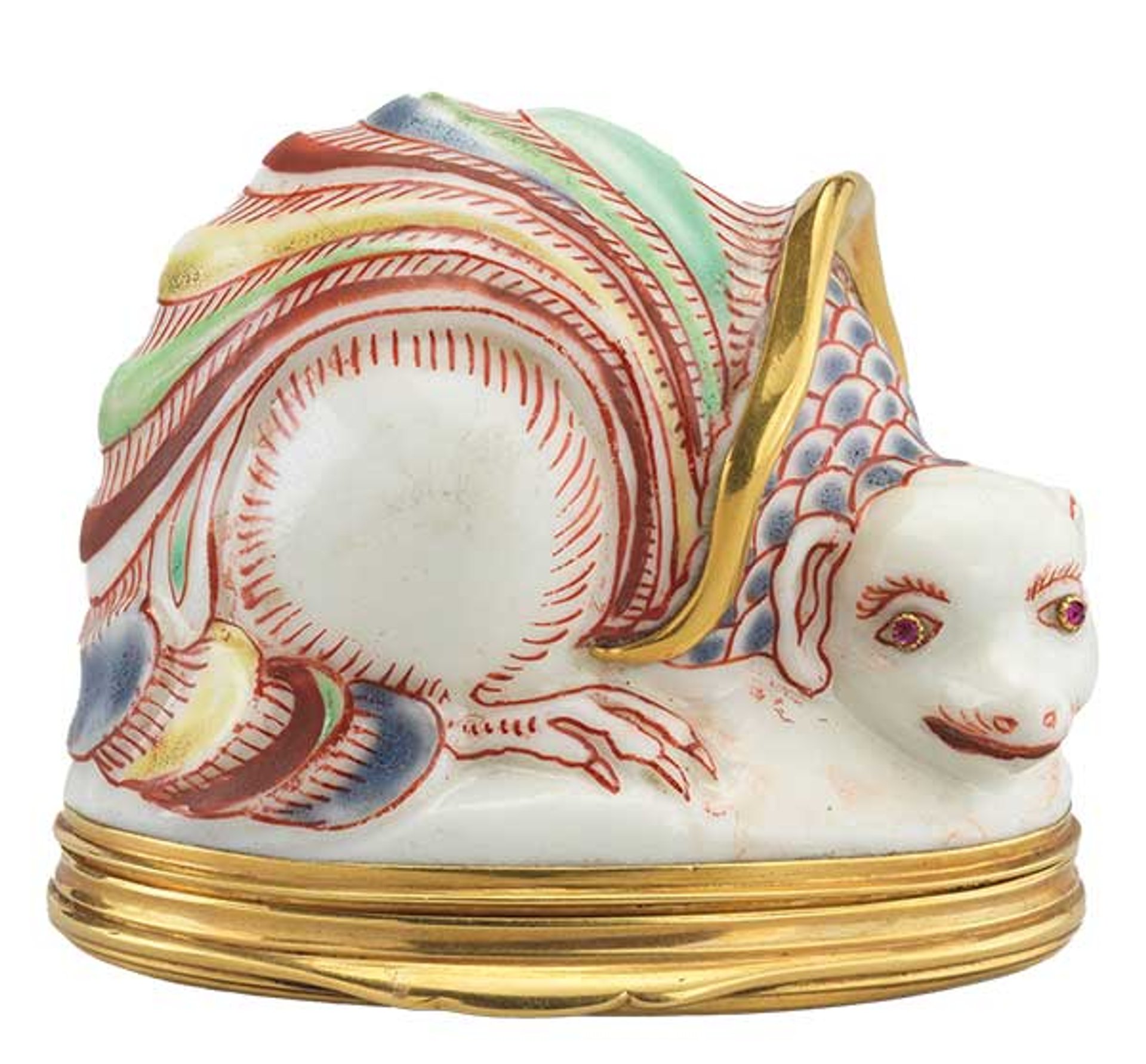
One of the perfectly formed and exquisitely crafted personal objects from the Pocket Luxury show
© CC0 Paris Musées/Musée Cognacq-Jay
In other words, in the 21st century, art, like sport, has become a product that might not change the world, but can enhance the value of a brand, a city or a country. This would appear to be a very different situation from, say, London in the 1990s, when the Young British Artists were creating fiercely conceptual works that were the antithesis of luxury products, reflecting the vibrant grunginess of the UK capital city pre-gentrification. Since then, successful artists like Damien Hirst, Tracey Emin and Glenn Brown have made millions from selling paintings at dealers’ shows and international art fairs. The grand period properties that Emin and Brown now own can be admired in Tiqui Atencio Demirdjian’s recently published coffee table book, Inside the Homes of Artists.
Luxury as a brand property
As Saint Léger points out, luxury is essentially an 18th-century French concept that has been co-opted by today’s global marketing machines. “The 21st-century luxury goods market embraces everything from jewels and luggage to private jets,” she says. “In yoking a brand to luxury, advertisers draw on a vintage notion of refined taste, harking back to a world of connoisseurs, exquisite workmanship and, above all, sophistication.”
It was exactly this notion that drew so many wealthy international visitors to Paris for its inaugural Art Basel fair and the city’s other elegant attractions. With a new US Republican administration likely to further enrich the high net worth individuals, the promise of “experiential luxury”, rather than just looking at art, seems to be the way forward for 21st-century art fairs.
But the luxurification of the art market makes it more vulnerable than ever to the fickleness of fashion. Gerald Reitlinger’s classic early 1960s study of the art market, The Economics of Taste, informs us that over a century ago, in 1898, when the US millionaires of the Gilded Age were crazy about collecting ‘pocket luxury’, John Pierpont Morgan gave what was then the enormous sum of £3,400 for an 18th-century French enameled box decorated with subjects after Fragonard. Six years earlier, the National Gallery had bought Vermeer’s masterpiece, Lady Standing at a Virginal (1670-72), for £2,400.
No one remembers the box.
[ad_2]
Source link