
[ad_1]
A flood of Van Gogh exhibitions in the form of fully immersive, multi-sensory experiences proved a hit globally last year after L’Atelier des Lumières’s version was featured on Netflix’s Emily In Paris. Since then, the industry has continued to grow substantially as investor money is poured in.
A clear sign that investors were taking notice of the huge popularity of these shows came in January, when Goldman Sachs Asset Management led a funding round that brought in $227 million for Fever Labs, the company behind the blockbuster “Van Gogh: The Immersive Experience,” which first opened in 2018. The largest-ever round of funding for a live-entertainment startup, Fever claims it brought its pre-money valuation to more than $1 billion.
In the months since, the company has a range of new offerings, including “Mexican Geniuses,” dedicated to Frida Kahlo and Diego Rivera; “Small is Beautiful,” dedicated to the miniature art movement, and “Klimt: The Immersive Experience.” The company also specializes in events relating to Netflix hit shows like Stranger Things and Bridgerton.
A spokesperson for Fever told Artnet News that the company’s revenues have grown 10 times and, in the past five years, it has expanded from three cities to more than 60 across Europe, America, Asia, and Oceania.
“Our global presence allowed us not only to mitigate the impact [of the pandemic] but also to see how despite the change in behavior during periods of restriction, as restrictions eased people still preferred face-to-face events and so began the growth,” the spokesperson said.
Corey Ross, CEO of Lighthouse Immersive, another giant of the sector, attributes the popularity to the medium’s novelty. “I have been experiencing art in art galleries since childhood and the presentation has more or less stayed the same—paintings on the walls with labels. The public is extremely curious to experience a new genre, and one they have seen it done well they love it,” he told Artnet News.
Lighthouse has worked with a team of more than 850, including creative director and theater designer David Korins and artist Massimiliano Siccardi.
Subjects like Van Gogh, Monet and Kahlo have widespread appeal. Lighthouse Immersive reported selling more than five million tickets to “Immersive Van Gogh” between February 2021 and May 2022, indicating that one in 90 Americans had bought a ticket.
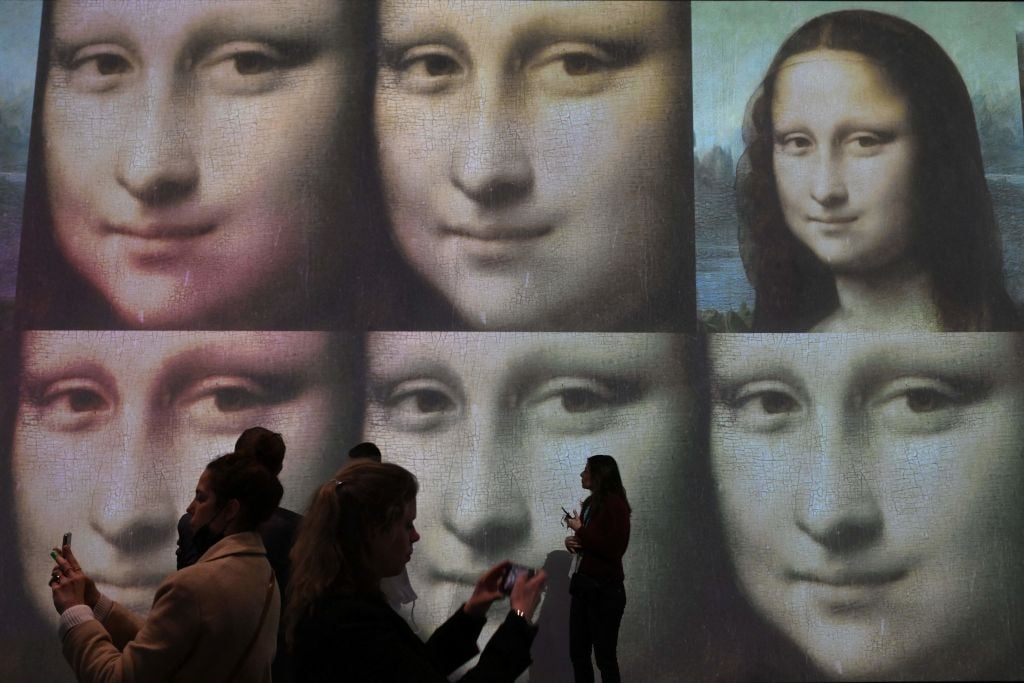
Visitor watch a giant screen showing details of Leonardo da Vinci’s portrait of Mona Lisa prior the opening of the exhibition titled “La Joconde, an immersive exhibition” at the Palais de la Bourse in Marseille. Photo by NICOLAS TUCAT/AFP via Getty Images.
Museums have long been under pressure to hold exhibitions dedicated to blue-chip names for the guaranteed footfall. Many are hopping on board with this latest trend, including Newfields’s the Lume Indianapolis, LACMA’s Pipilotti Rist show, and the Louvre and Grand Palais’s immersive light exhibition inspired by the Mona Lisa. Ticketed events also provide a new model of making commercially-viable work for new media contemporary artists, such as those exhibiting through ventures like Pace’s Superblue.
Immersive art experiences have proven particularly popular in the U.S., which accounts for 40 percent of Fever Labs’ revenue. These kinds of shows have a much longer history in France, however, according to Pascal Bernardin, founder of the Encore Productions behind “Imagine Van Gogh, the original immersive exhibition in Image Totale.” He refers to the venue Cathédrale d’Images, now Carrières des Lumières, in the South of France. Established by the photographer Albert Plécy in 1977, he used the space to screen art. In 2008, creative director Annabelle Mauger held what is likely the first immersive Van Gogh show and “Gauguin and Van Gogh, the color painters” followed in 2012.
The considerable growth of this sector since has no doubt been bolstered by the low cost of using images old enough to be in the public domain and the high ticket prices typically being charged, including $45 dollars at the weekend for Fever’s Van Gogh exhibition and at minimum $35 dollars for Lighthouse Immersive’s new showing of Klimt.
“The problem with immersive shows is they are very cheap to do,” said Bernardin, who is dismissive of the sudden proliferation of immersive Van Gogh experiences and decries the lack of critical engagement to differentiate them by quality. “You just buy 20 projectors… give me $100,000 and an American city and I could produce an immersive show of bad quality tomorrow.”
[ad_2]
Source link