
[ad_1]
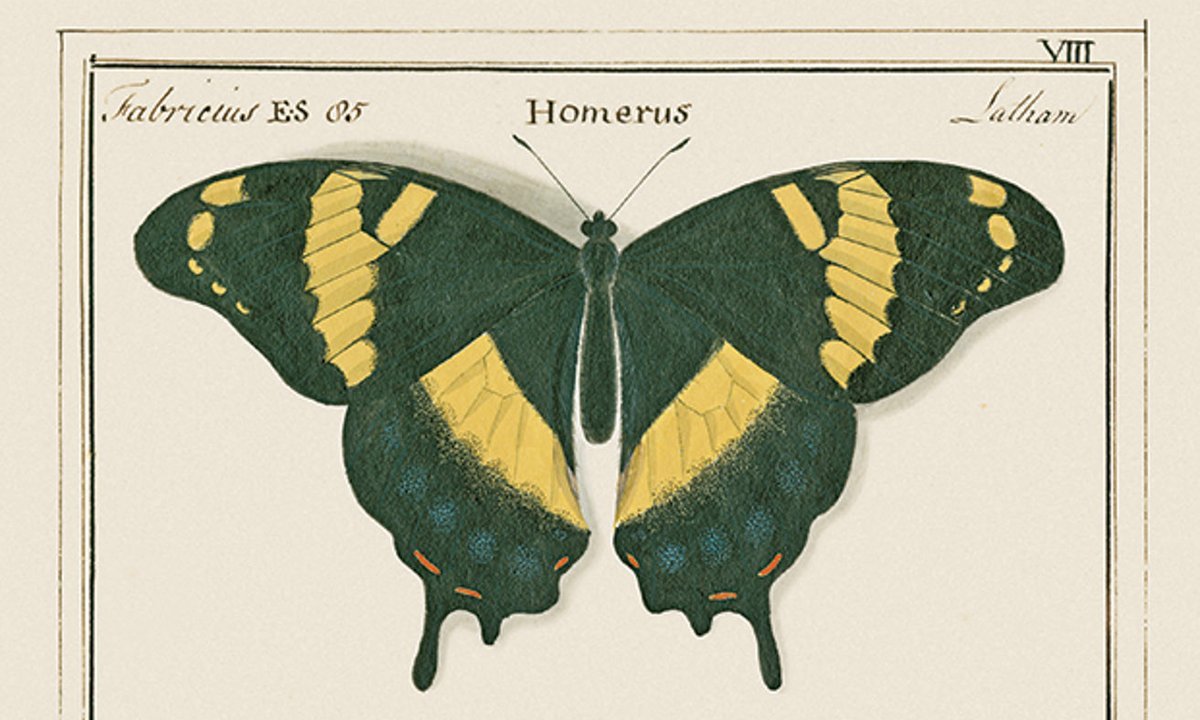
From around 1780 to 1810, William Jones “of Chelsea” (1735-1818)—skilled painter, scholar and naturalist—created almost 1,300 images of butterflies and moths, covering 856 species, using specimens in the London collections of the early doyens of entomology (the study of insects). Among Jones’s associates were the Danish zoologist Johann Christian Fabricius (one of the Swedish scientist Carl Linnaeus’s most productive students), the physician and collector William Hunter (of Glasgow’s Hunterian Museum fame) and the botanist Joseph Banks.
Unpublished and privately owned until the early 20th century, Jones’s archive over time came to Oxford University and his original seven volumes are combined in Icones. Butterflies are identified and mapped, providing unique insight into global exploration towards the end of the Enlightenment and proof of the extraordinary diversity of the natural history specimens brought back for analysis and display in European cabinets. Jones’s illustrations are remarkably accurate in form and colour; science and art combine in an exquisite history as relevant today as it was more than two centuries ago. Several previous plans to publish the Icones failed and, although the paintings became publicly available online in 2015, they are presented here in hard copy “enhanced facsimile” for the first time.
“The illustrations are remarkably accurate in form and colour”
That Fabricius based 231 species descriptions on Jones’s paintings (hence ‘iconotypes’) is of critical scientific importance. They include Fabricius’s 1793 description of the Jamaican endemic swallowtail butterfly Papilio homerus, one of only four butterfly species currently afforded protection under the Convention on International Trade in Endangered Species of Wild Fauna and Flora Schedule One. The British Large Copper, long extinct, is beautifully painted, but under the name of a European species unconfirmed as ever existing naturally on our shores. Jones also painted the infamous Papilio ecclipsis—the Linnean butterfly equivalent of the “Piltdown Man” fraud—from the only specimen in the Natural History Museum: in fact an ingeniously hand-painted Brimstone butterfly, later deliberately destroyed by a member of the museum staff when the skulduggery came to light.
Icones includes some interesting early misconceptions. Sexually dimorphic males and females of some butterflies were believed to be different species and a painting of a colourful day-flying tropical uraniid moth is presented as a swallowtail butterfly with clubbed antennae, suggesting the antennae (like most moths, in fact not clubbed) were broken or missing from the specimen.
The wealth of imagery is enhanced by an introduction from the former keeper of entomology at the Natural History Museum and butterfly expert, Dick Vane-Wright. He weaves the story of Jones, his accomplishments, painting techniques and colour construction, alongside his most significant contemporaries, into a comprehensive and highly readable whole. Contributions by others on the early study of Lepidoptera, 18th- and 19th-century collecting, the art of painting, and a general decline of butterflies and moths around the globe are in context—although the shadow of a non-entomological hand is evident. A page of “butterflies no longer found in the British Isles” is flawed; the Chequered Skipper is alive and well in Scotland.
Such blunders aside, Thames & Hudson and the Oxford University Museum of Natural History are to be congratulated on producing a book of considerable scientific value and artistic beauty. As a modern research source—at a time when habitat destruction and a changing climate are a reality and decline of butterflies globally is alarming—it is invaluable. Without doubt, this impressive volume will result in further research and discussion.
• Introduction by Richard I. Vane-Wright, Iconotypes: a Compendium of Butterflies and Moths. Jones’s Icones Complete, Thames & Hudson/Oxford University Museum of Natural History, 688pp, 1,600 colour illustrations, £65 (hb), published 9 November
• John Tennent is a scientific associate, department of life sciences, in the Natural History Museum, London. Author of more than 275 scientific papers and reviews, he has most recently carried out research into Pacific butterfly biogeography and systematics on some remote islands of the south-west Pacific, and described more than 180 butterflies new to science—many he discovered. In 2007, he was awarded the Linnean Society HH Bloomer Medal for contributions to science
[ad_2]
Source link