
[ad_1]
The streets surrounding William Kentridge’s home in northern Johannesburg are lined with trees of exorbitant beauty: jacaranda, blue gum and London planes arch overhead to form a luminous-green tunnel. The light in “the city of gold”, as it is named for the reefs of mineral on which it is built, is always stunning, but the scenery is usually far grittier. As I round a steep corner in my car, the sun’s rays are so dappled it would give the American “painter of light” Thomas Kinkade a run for his money. I pull over to take a photograph. I’m clicking away when a man barely dressed in rags bangs on my car window and starts screaming obscenities.
It turns out that I’ve stopped right in front of Kentridge’s home, which feels apt. The work of South Africa’s greatest living artist is deeply rooted in the city in which he has lived for most of his life. The contrast between the affluent street submerged in sunlight and the failed promises that have left the metropolis struggling with homelessness and broken services are an ever-present undercurrent in his works, whether in his rough-hewn charcoal drawings of trees or experimental animations depicting post-apartheid South Africa.
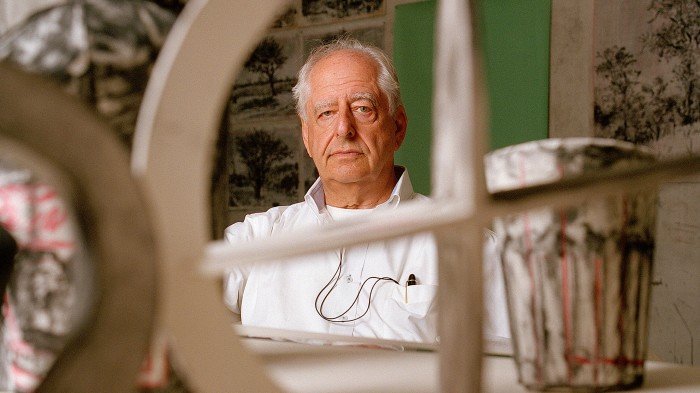
I walk up the driveway to the English arts and crafts‑style house where he lives with Anne Stanwix, his wife of more than 40 years, a rheumatologist. Sitting in the light-filled home studio in his garden, Kentridge tells me the deep political vein that runs through his works isn’t always conscious. It “sort of sinks in . . . in ways that I’m not aware”, he says. White-haired with a shock of white eyebrows and dressed in a crisp white Oxford shirt, he has the air of a professor, at once pensive and appraising. Although he’s “never thought of the work as being a history of Johannesburg, if you put the films next to each other, they become a kind of history of what’s happened in the city”.


The house itself, designed by the English architect Frank Emley and his partner Frederick Williamson in the early 20th century, is the one he grew up in, and which he inherited from his parents when they relocated to London in the 1990s. Accordingly, it still has “cupboards full of relics from the 1960s – my father’s military uniform, my mother’s wedding dress.”
To that he has added a significant collection of prints, including an etching by Dürer of a rhinoceros and another by Edward Hopper, puppets from his theatre productions, and his own sculptures and drawings. An entire wall of the living room is lined with his small bronze sculptures, which he has described as the symbols that form his artistic vocabulary: an open pair of scissors, a gramophone, a horse walking along. Tapestries, rugs and wall hangings cover the walls and floors. And there are hints of the presence of his small grandchildren, such as a treehouse in the beautiful English country garden, about the house.
There are also lush, neatly trimmed lawns and sumptuous ornamental plants, many planted there during his boyhood by his parents. Alongside a mature belhambra tree are jacarandas, which will spread a carpet of purple flowers in spring, and cacti. “We worked very hard on it since our daughter wanted to get married in the garden. What was meant to be a six-month project has been 10 years and ongoing.” He has another studio, an art centre which he runs with the Botswana-born visual artist Bronwyn Lace called The Centre for the Less Good Idea, which they use for experimental, multidisciplinary art and theatre projects with local artists. The name comes from a Setswana proverb, “if the good doctor can’t cure you, find the less good doctor”, and reflects Kentridge’s abiding desire to stay connected. “The space in town, the other studio, is very different,” he says. “Otherwise you live in a bubble – it’s not Johannesburg.”


Of course, Kentridge’s works go beyond chronicling one of Africa’s grandest metropolises. You can also see traces of the events that have defined South Africa: from the Sharpeville massacre in 1960, where police fired on peaceful Black protesters, to the 2021 riots across South Africa against the ruling ANC party.
“What’s amazing about William’s work is that, yes, it is political. But by the same token, it has a strong personal and philosophical aspect to it, so it transcends our history,” says Liza Essers, the owner of the Johannesburg-headquartered Goodman Gallery, which has represented him for more than three decades. “It resonates hugely for people [everywhere].”

All this is achieved through what one critic described as a “darkly imaginative circus” of print-making, drawing, theatre, animation and music, which has been exhibited everywhere from the Louvre to the Met. Today, his works on paper sell for an average of around £70,000, while his record is more than £1mn for a multi-part bronze sculpture. He is best described as a maestro of towering, riveting Gesamtkunstwerke, which combine his own illustrations and animations with choral opera, theatre and dance.

Now, as he turns 70, he is having a moment even by his own prolific standards. Next month he will open A Natural History of the Studio at Hauser & Wirth’s New York gallery, his first show with them in the city. There, he will show his nine-part film, Self-Portrait as a Coffee-Pot, which launched on streaming platform Mubi last year, and a series of sculptures and drawings that went into the film’s creation. In June, he will open The Pull of Gravity at Yorkshire Sculpture Park, his first major sculpture presentation outside South Africa.


Evidence of more forthcoming work is visible around his studio. On the ground floor, his team have assembled a miniature, true-to-life replica of the opera room at Glyndebourne in Sussex, where his production of Monteverdi’s L’Orfeo will play in 2026. “We always make a model big enough to see how the projections will look in the real thing,” he says over the haunting contralto voice in Jordi Savall’s arrangement. “The final piece will be the orchestra and the singers, the set, the projection. There’s many layers to look at,” he says of the production that has been two years in the making.

Upstairs, in a Persian-carpeted room, two assistants are making digital edits to Kentridge and theatre director Lara Foot’s reworking of a production of Faustus in Africa!, which will play at Edinburgh’s International Festival. The original debuted in theatres in 1995, a year after South Africa threw off the shackles of apartheid, and used puppetry, animation and Goethe’s Faust legend as a springboard to explore the contracts that ushered in post-colonial Africa. If the questions it poses (without giving answers) seem to translate to today’s biggest issues, “it’s not that they’re universal”, Kentridge explains, “it’s that they’re iterative – they come back”.
Later that evening, Kentridge will board a flight to San Francisco to attend a showing of his chamber opera The Great Yes, The Great No. The piece fictionalises the wartime escape from Vichy France by cultural figures such as André Breton, Claude Lévi-Strauss and Wifredo Lam.
Does he have any plans to slow down, I wonder, as dogs pad around the studio (only one, a cheerfully overweight chocolate Labrador, is his; the rest belong to the team of assistants). He replies: “Any time I think I should stop, I get another idea…”


Kentridge was born in 1955, to Jewish lawyers who fought against apartheid; his father represented Nelson Mandela. His early years were steeped in politics. In the past he has talked about the moment he went rifling through his father’s desk looking for sweets, and instead came across photographs of victims of the Sharpeville massacre, whose families his father represented in the inquest. He has described it as “one of those moments when one’s understanding of the world turns a sharp corner”.
He studied politics and African studies at university before going on to the Johannesburg Art Foundation art school, and in 1975 began directing and acting in theatre productions. A stint in Paris to train as a mime was short-lived when he realised he would never be an actor. On his return to Johannesburg, he went into film production instead. “I said to my wife that we would have our first child when I’d made my first feature film,” he says. “Luckily, she didn’t listen to me or we’d still have no children. As it is, we have three children and no feature.”
His “third life” as an artist began in his late 20s. His series of charcoal-drawn animations, 9 Drawings for Projection, was first released in 1989 and swiftly gained him global recognition. Today his work is held in collections at the Tate Modern, MoMA and the Pompidou.


It was the period of incubation that came with the pandemic that gave rise to what will be seen at Hauser & Wirth. “It was fantastic to have so many months of no travel, of just being in the studio on my own,” he says of Self-Portrait as a Coffee-Pot, which finds Kentridge in conversation with himself. He explores the creative process in the studio while we watch the constant erasure and drawing-over of charcoal images that transform from one thing to another, a cup to a fish or a vase to a word. “You want to draw a masterpiece,” he sighs during the piece, in commiseration with himself, “but what you end up drawing is… a coffee pot.”
“It was about how to make sense of the world from inside the studio,” he says today. “Very much the studio as an enlarged head, the thoughts in your head echoed in the movement around the studio.”
“William’s exploration of memory, history and the experience of the human body is especially powerful – and poignant – in a time of such precarity and uncertainty in our world,” says gallery owner Iwan Wirth. “He brilliantly expresses both human vulnerability and resilience, the impact of trauma and the possibility of hope.”

At Yorkshire Sculpture Park, The Pull of Gravity will engage more explicitly with politics. The show was conceived in the wake of the war in eastern Europe. “It was a few weeks after the invasion of Ukraine and we were both so full of this cataclysmic event,” says Clare Lilley, the gallery’s director. “It led to a centre point of the exhibition being about hubris.” As such, there are sculptures of horses and bronzes, more than 3m tall, of striding figures with megaphones for heads.
Kentridge insists I stay for a cup of tea and slices of fresh mango. His staff gather for a break, and the gentle buzz of conversation starts up around the room. The chocolate Lab snoozes next to the table.


Although his output is prolific, Kentridge questions his own sense of creative fulfilment. “The harder part of being an artist is that you need to have a gap, you need to have a lack,” he says. “If you’re satisfied, if you’re fine as yourself, then you can just get on with your life. You don’t need to keep on making all these millions of…” – he mimes scribbling the same rapid, sweeping strokes that appear in his animations, “that you need other people to look at.”
But he has allowed doubt to become part of his creative process. “The first idea you have when you’re doing a project seems such a clear, good idea, and then as you work on, it’s not quite so good,” Kentridge continues. He’s talking about creativity itself, of course, but also the grand ideas of the 20th century. “Then, you’ve got a choice of either becoming more and more certain, and more and more strident, or else you can accept that it doesn’t work and that you need to find new ideas from the cracks,” he says. “What is the push to make something that’s beyond yourself, that remains when you step away from it?”
A Natural History of the Studio is at Hauser & Wirth, 22nd Street, New York, from 1 May to 1 August. The Pull of Gravity is at Yorkshire Sculpture Park from 28 June to 19 April 2026. Monica Mark is the FT’s Southern Africa bureau chief
[ad_2]
Source link