
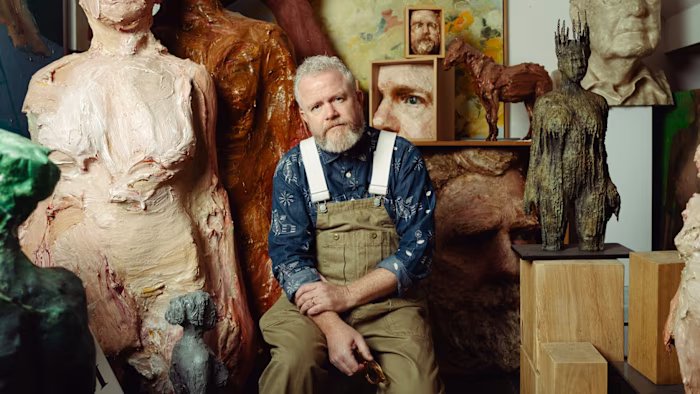
In his kitchen, Colin Davidson makes a pot of tea under the watchful gaze of Ed Sheeran. I follow him through the door into his studio, up the stairs, past Queen Elizabeth II, and sit down next to Bono. As I take my place by Davidson’s easel, I wonder whether, after producing more than 350 portraits in the past 16 years, the northern Irish artist scours every face he meets with forensic scrutiny.
I need not have worried. Sitting in the 150-year-old converted stable block that houses his studio at his home in Bangor, near Belfast, I don’t feel his stare boring into me. In fact, at some of my questions, he takes off his glasses and screws his eyes shut, searching for the right reply. He speaks slowly, thoughtfully. In his casual uniform of dungarees, corduroy waistcoat and clogs, Davidson, 57, seems at times uncomfortable at being on the receiving end of the attention, rather than doling it out — something he appreciates can feel, for a sitter, “incredibly unnerving at the start”. He has painted politicians, cultural greats and celebrities, including Bill Clinton, Sir Kenneth Branagh, Angela Merkel, Seamus Heaney and Edna O’Brien. “Making a painting of a human face or head is difficult enough,” he says, “but making a painting of a human head that has to look like the person is infinitely more complex. You can ruin a painting by trying to get the likeness right, and you can ruin a likeness by trying to get the painting right.”
For Davidson, the job of a portraitist is to “quarry” beneath the facade someone presents to the world, rather than to render a photographic likeness in oils. “What’s really important to me is that I’m after the truth,” he says. “I don’t want to in any way invest the painting with a self-indulgent sense of who I think that person is. There has to be an honesty to it.” Which is how he came to capture Brad Pitt just after the exhausted actor had got off a transatlantic flight, looking nothing like a Hollywood star. Or the former US president looking uncharacteristically uncertain.
Davidson is discreet enough never to reveal the detail of what he and his subjects discuss as he works. It’s a process that typically begins with him photographing them, sometimes in their homes, sometimes at his studio, and filling his sketchbook with pen studies that he’ll call on back in the studio. The late Queen, whom he painted in 2016, started to relax about 30 minutes into her sitting at Buckingham Palace, beginning to reveal a great-grandmother, talking about her 90th birthday. “Those are the bits where she’s letting me in to glimpse somebody other than that face we see on £20 notes,” he says. The resulting portrait is neither regal, nor especially flattering. “People know that I will never be unkind, but I will never use an airbrush. I will paint what I see, and paint what I feel.”


As a child growing up in south Belfast, he had a pronounced stammer and low self-confidence until he discovered a talent for drawing. It offered him a way to express himself, and a new sense of self-belief. He first made it as a graphic designer, then as a successful artist, working both to commission and simply to “challenge” himself (I note the sleek dark green Porsche parked outside, as I pull up in my grubby 14-year-old Golf). Yet I spot a shadow of defensiveness in him. He is gracious when I ask about his stammer, which occasionally flickers still, and candid about how his self-worth is tied up in being an artist, even as he maintains he does not particularly seek the approval of art critics, or belong to any scene. He has a show on in Dublin and a new book, based on conversations with his friend, the BBC journalist Mark Carruthers. And yet he hesitates. “I wonder if I’m still on that road of [art] positively needing to define me,” he muses. “Without it, the inner child in me doesn’t really have a huge amount of confidence in what I have to offer, who I am.” When I ask him what it is that he would like to hide from people’s quarrying eyes, he ducks. “I might not answer that.”
Davidson’s most high-profile show featured no celebrities at all: Silent Testimony (2014-15) exhibited in 2024-25 at London’s National Portrait Gallery after being shown in Paris and New York. In it, he used his habitual 127cm by 117cm canvases to depict 18 ordinary people who suffered devastating loss during the Troubles. His aim was to “look at the familiar in a new way”. The people he painted — haunted, resilient, dignified — are an everyman and everywoman in a region where the legacy of the conflict still overshadows three decades of peace. “Really, all I was trying to do at the start was say, look, let’s just stop and think that, amongst us, these people exist,” he says. “And that, as a society, as we talk about moving on, actually there are thousands of people that can’t.”
Raised in a “very religious Christian Protestant home” — although now he wouldn’t describe himself even as a Protestant — he has painted people of all beliefs. He considers his Silent Testimony paintings among his most meaningful and personal work. Since finishing the project, he has become a patron at the Wave Trauma Centre, which supports victims of the Troubles. Wave helped him identify the people he would paint in Silent Testimony.
Many of the subjects of his other portraits were the result of “serendipitous” encounters. His first large portrait came about after bumping into the friend of a friend whom he had known for years, the musician Duke Special. Special introduced him to the Irish singer-songwriter Glen Hansard. Hansard then featured Davidson’s portrait of him on the cover of one of his albums. Brad Pitt saw it, as well as some of Davidson’s other work at the Royal Academy in London, and asked him to give him painting lessons (he did, and also painted Pitt’s portrait twice). Another personal introduction led Davidson to paint former Dire Straits frontman Mark Knopfler. Six degrees of separation is usually too much in a small place like Northern Ireland, but it continues: Olympic gold medallist pentathlete Lady Mary Peters came to view Davidson’s portrait of her with one of her oldest friends, who turned out to be Ed Sheeran’s granny, and this led to Davidson painting the singer’s portrait.
Through his friend Carruthers, then chair of Belfast’s Lyric Theatre, Davidson began painting actors. That association led to him painting the Queen, who in 2012 famously shook hands with the late former IRA commander and deputy first minister Martin McGuinness, whom Davidson also painted.
Despite all this, he resists being pigeonholed as a portraitist. One of his most enduring subjects is Belfast, lovingly rendered in detailed cityscapes. His current exhibition in Dublin is of his Stranger series, which he calls “paintings that you can walk around”. The two-metre-tall faceless figures, gathered in his studio when I visit, are 3D-printed from maquettes crafted from layers of thickened oil paint, which Davidson regards as “another blank canvas which I then attack with acrylic paint”.
We’ve been sitting in the studio for two hours under the steadfast gaze of Bono, whose 2021 portrait (he has painted the singer several times) rests on the easel. “I neither want, nor expect, nor need everybody to like my work,” Davidson says. “Every blob of paint I put on the canvas is for me. I do not have a hint of ‘what is anybody going to think of this?’ as I’m doing it . . . It’s ultimately about me, a reflection of me. It’s a self-portrait.”
Jude Webber is the FT’s Ireland correspondent
“Colin Davidson: Twelve Paintings — Conversations with Mark Carruthers” is published by Merrion Press. “Stranger” is at the Royal Hibernian Academy of Arts, Dublin, until January 25
Find out about our latest stories first — follow FT Weekend Magazine on X and FT Weekend on Instagram