
[ad_1]
h: What was the catalyst for you to enter this industry, and what drew you to prosthetics in particular?
MF: The very first time it hit me was when I was three years old and watched The Wizard of Oz, seeing the Wicked Witch’s green skin and being slightly terrified of it. I didn’t understand that it was fake. But a few years later, when my dad showed me Thriller by Michael Jackson, there was a “making-of” that showed Rick Baker taking Michael Jackson’s life cast and applying the makeup. It suddenly clicked that this was an art form and a job. I knew right then that this was what I wanted to do with my life.
h: Which project has been particularly dear to you, and why?
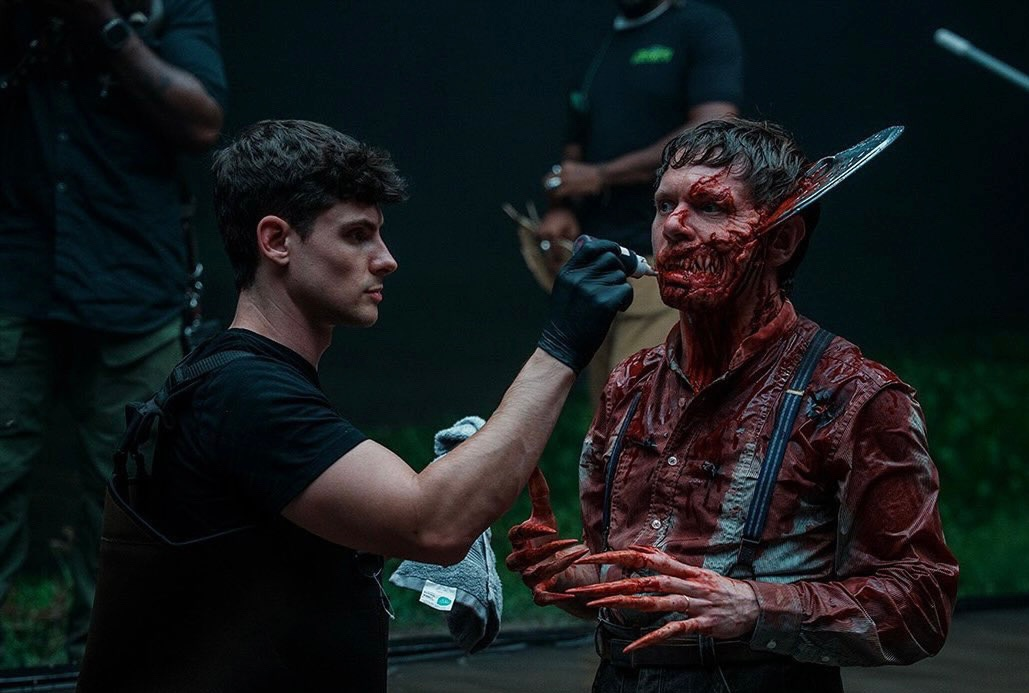
MF: Sinners is particularly dear to me for so many reasons. The scope of the work was so massive that I really had to pull out every trick I had learned in my career. I had such an amazing team, and it was a privilege to go to work with them every day. Ryan Coogler’s script set us up for success right from the start, and as a director, he’s so collaborative. It really felt like a family working on that film.
h: On Sinners, you led a team of 26 artists. How did managing such a team change your role, and how did the experience push you to grow as an artist?
MF: I knew managing the team was a big responsibility, and I didn’t want to let anyone down. They were all looking to me for answers and direction. But I also didn’t want to give up doing the artwork. I get so much joy out of sculpting and doing makeup on the actors. Because of that, the work was really intense for me, but it was worth it. Every single person on the team was such a heavy hitter. Kevin Wasner was my Key on set, and he amazed me with the way he could solve any problem and invent things right on the spot. One of my heroes, Carlos Huante, came on to do concept art. And two younger artists that I helped get their start, Greg Pikulski and Brett Schmidt, oversaw the lab work. It was the best.
h: Prosthetics and makeup involve a special kind of intimacy—both physical proximity and the vulnerability of being closely observed. Has working within that intimacy always felt natural, or is it something you’ve developed over time?
MF: It always felt natural to me. I’m a very social person, and connecting with other people is a big part of why I love to do this. I think it’s why I didn’t become a painter or prefer to work in solitude. Film is such a collaborative medium.
h: Collaboration is central to your work. How do you approach working with directors, actors, and other departments to realize a shared vision?
MF: It might sound like a basic answer, but I think it really helps to see their movies. I was a big fan of Josh Safdie’s and Ryan Coogler’s films long before I knew them or worked with them. And they had seen films that I worked on. So when we met for the first time, in a strange way it was like we already knew each other. It’s the same thing with other department heads and actors. When you actually sit down to start figuring out how to tackle the project, you have a sense of where they’re coming from artistically, and you can speak their language.
[ad_2]
Source link