
Down a trapdoor hidden beneath a rug in a family home of Frida Kahlo, the artist kept a workshop with the cool remove of a sanctuary. In the dark, low-slung space, she surrounded herself with collections that reflected her eye for unconventional beauty: taxidermied insects, oil ex-voto prayer scenes, and Asian lacquered-skin dolls in ancient dress. Kahlo, her family says, could spend hours or days in the room, writing, painting, and retreating from the chaos that surfaced at times in her life above ground.
“It’s like her most sacred refuge,” said Adán García Fajardo, the director of the new Museo Casa Kahlo in Mexico City, as he walked into the cellar space on a tour earlier this month. The museum, set in a clay-red house that has been in the hands of Kahlo women for four generations, will open to the public for the first time on Saturday, offering a distinct perspective into the life of the Mexican artist in a city already crowded with tributes. The cellar is its centerpiece. Along with a drafting table strewn with her paintbrushes and glass exhibits of her curios, the room now displays dozens of photographs and revealing letters written by Kahlo, many never before shown from the family archive.
(In praise of difficult women: The inconvenient spectacle of Frida Kahlo)
More than 70 years after her death, Kahlo is among our most recognizable cultural icons, with a visage, fixed in a serious gaze beneath a unibrow, reproduced on everything from throw pillows to the silver screen. A churn of biographies, documentaries, children’s books, and art tomes have recalled the details of her remarkable story—of the bus accident when she was 18 that left her in lifelong pain and her tempestuous marriage with the giant of Mexican muralism, Diego Rivera.
In Mexico City, the Casa Azul, where Kahlo grew up and later lived with Rivera, is a pilgrimage site for her fans, filled with heirlooms and many of her most famous works. Her paintings, with deeply personal imagery staged in often-dreamlike scenes, continue to fetch astonishing figures at auction. And perennial retrospectives, like the one scheduled for next year at the Houston Museum of Fine Arts and the Tate Modern in London, have examined her influence on Surrealism, fashion, and as an emblem of social movements like feminism and gay rights.

Designed by Rockwell Group, the courtyard of the Casa Roja has been restored to reflect the various generations who lived in the house. A young grapefruit tree—the subject matter of Frida’s mural in the kitchen—sits in a Cantera Stone pot, crafted by the famed stone carvers from the town of Escolásticas. In front of the tree, a carving in the stone flooring depicts one of Cristina Kahlo’s personal rugs that used to sit in the entry of the home, welcoming all into the house. Photograph by Rafael Gamo for Rockwell Group
Still, there are sides to Kahlo that the world doesn’t know.
“Everybody is like, ‘Oh, she was very resilient and very brave and very strong even through the physical pain. She never smiles.’ You know what? She was missing a tooth! That’s why she never smiled,” says Mara de Anda, Kahlo’s great-grandniece who, along with her mother, created the new Museo Casa Kahlo.
A fiercely protective family
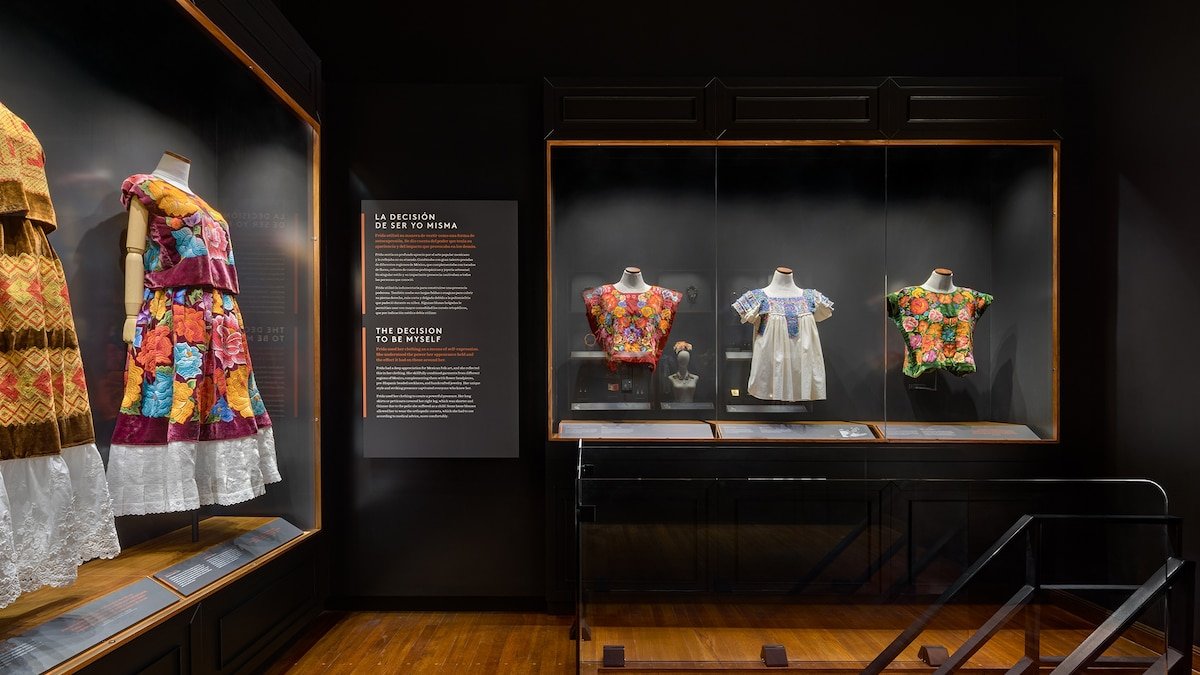
The museum unfolds like a family memoir throughout the rooms of the converted home, illuminating lesser-known parts of Kahlo’s story, like her personality, her childhood, and the relationships she relied on with her parents and siblings. In the entry hall, a family tree traces the Kahlos’ lineage alongside antique photos taken by Guillermo Kahlo, Frida’s father, who became a professional photographer in Mexico after emigrating from Germany. Nearby is a gelatin silver print that shows a sweet-faced Frida at four years old in a white dress and high socks and one of her earliest pieces of art: a simple geometric house and tree embroidered on a canvas.
Kahlo’s mother, Matilde Calderón, bought the house that the museum occupies in 1930, after Kahlo and Rivera moved into the Caza Azul three blocks away in the colonial neighborhood of Coyoacán. The traditional Mexican neocolonial property, also referred to as the Casa Roja, was later passed from Calderón to her four daughters and then to Cristina Kahlo, the only one of the sisters to have children. Frida only lived in the house for a few months, when her studio at the Casa Azul was being remodeled, but she was a constant presence, in her cellar bolt-hole and in the kitchen alongside Cristina, whom she called her other half, according to family remembrances.
(See Diego Rivera’s giant fountain sculpture of an Aztec god)
The museum has few actual works of Kahlo’s art, unlike the Casa Azul, which is run by a trust administered by the Mexican central bank, but two pieces on display are indicative of her familiar style and themes. Tray of Poppies, a lush still life that Kahlo painted on a serving dish as a teenager, foreshadows an interest in the natural motifs she would return to over her career. On the wall of the kitchen is Kahlo’s only known mural, depicting a flock of sparrows holding a ribbon with a tongue-in-cheek epigraph for the room as a gathering place for freeloaders.
Much of the collection, including the letters sent between Kahlo and her family, is drawn from an archive that Isolda Pinedo Kahlo, the daughter of Cristina, amassed over decades inside the Casa Roja, where she lived. Additional letters were shared by the National Museum of Women in the Arts in Washington, which holds a trove of Frida Kahlo’s writings that she left to her doctor after her death. Together, the volume of the correspondence is so great—by some estimates Kahlo penned two or three letters every day of her life—that experts now consider her as much a producer of literature as a painter.
“You’re going to find a very loving Frida, a very generous Frida. She always had a sense of humor,” says Adriana Miranda, the chief curator of the Museo Casa Kahlo.
Early letters, sent following Kahlo’s move with Riviera to the U.S., where he had been commissioned to paint murals in Detroit, New York, and San Francisco, capture a feeling of homesickness in the 22-year-old.
(Peek inside Frida Kahlo’s Casa Azul)
“How are my little animals?” she writes in one. “Give the little yellow cat more treats than the rest.” In another, written months before her death in 1954, Kahlo laments her own struggles with infertility as she celebrates the birth of Isolda’s daughter: “You know how much I love you, now even more, because having given you away, you give me your girl, and so now I have two loves. The same ones that I wanted to have alive in my womb many years ago.”
Routinely, she signs off with a nickname: Fridu, Aunt Fisita, or Friduchi.
The letters “changed completely the panorama” of what was known about Kahlo’s life, says Luis-Martin Lozano, a preeminent Kahlo scholar and the former director of the Museum of Modern Art of Mexico. In 2007, Lozano was the first art historian given extensive access to the family archives by Mara Romeo, Isolda’s daughter, and Mara de Anda, her daughter, who are known together as the Maras. His research was published in the book Frida Kahlo: El círculo de los afectos.
“We discover that her family was extremely important for Kahlo,” Lozano says in an interview. “It didn’t matter that she had her very interesting international life, that she was an artist, that she was a communist, that she had bisexual relations. She had a family that was her anchor.”
“As an expert, this becomes interesting because this will explain many things that are happening in the paintings. The symbolism of many aspects in her paintings are related to these personal affections,” he continues.
Frida as cultural icon
The opening of the museum comes as the value of the Frida Kahlo brand reaches extraordinary heights. Next month, Kahlo’s 1940 painting El sueño (La cama), which depicts her sheathed in vines as she lies in a bed beneath a skeleton, is expected to sell for between $40 and $60 million at auction with Sotheby’s, which would break her own record for the highest price paid at auction for a Latin American artwork.
Ownership over the trademarks controlling Kahlo’s name and image has been contentious. After Kahlo’s death, her intellectual property rights under Mexican law passed to Isolda and then to a licensing corporation that Romeo founded with a Venezuelan businessman. But the rapid commercialization of the artist that followed led to disputes between the family and the group. In 2018, Romeo sued after Mattel announced plans for a Barbie modeled after Kahlo, winning a court order that temporarily halted its sale in Mexico. The doll, Romeo said at the time, “should have been a much more Mexican doll, with darker skin, a unibrow, not so thin because Frida was not that thin.”
“Our objective as a family has always been to protect Frida and to teach about her,” de Anda says.
The adaptation of the Casa Roja as a museum is their biggest step yet in reshaping Kahlo’s legacy. The project has been in the works for 20 years, de Anda says, as she and her mother sorted through her grandmother’s mementos and catalogued them for display. The house’s central garden was reconfigured as a patio to better handle the expected crowds and a well-lit staircase was added that descends into the cellar. Two years ago, in a final act of preparation, the family found a new home for Romeo, who had still been living in the Casa Roja.
“That is the magical thing about this house, the responsibility that we as a family have to share it with the world,” de Anda says. “We need to tell the real story, with the real letters, with the real things that belong to her, to her family.”