
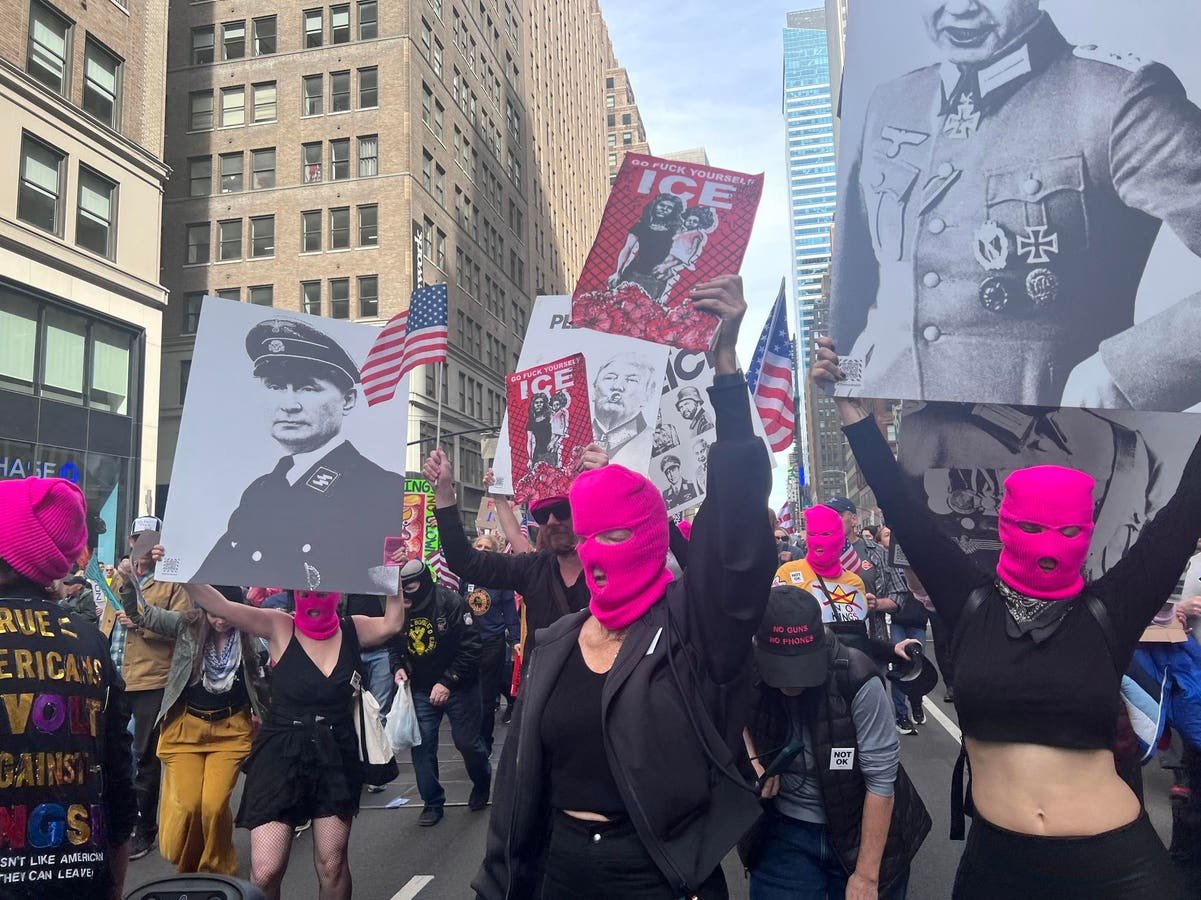
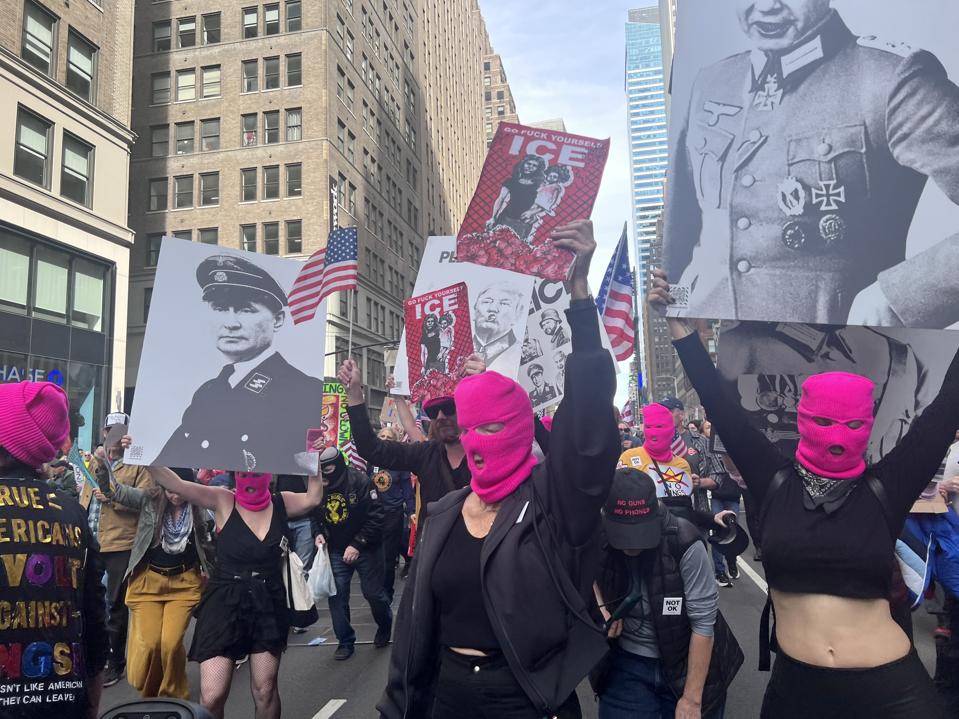
Pussy Riot column organized by local NYC Pussy Riot activists Luisa de Miranda and Rayme Silverberg, ICE sign by Molly Crabapple, at No King protest in Manhattan. Image shared by Pussy Riot co-founder Nadya Tolokonnikova.
Luisa de Miranda
“We showed up as Pussy Riot because they’re proof you can’t stop rebellion. Putin tried — and they only got louder. Trump’s America is just another face of the same authoritarian machine. We’re not here to bow to kings, billionaires, or wannabe dictators. The Constitution is our riot act — not theirs. No crowns. No thrones. No compliance. When women rise, the world rises with us,” proclaimed art historian, film set decorator, book editor, visual artist, and fullstack software engineer Luisa de Miranda, who co-organized the column (a formation of people moving together in a long file, with each person standing one behind the other) on behalf of Pussy Riot. The term column is borrowed from military drilling and is used to move a large number of people efficiently from one point to another.
The presence of performance artists like Pussy Riot, a Russian feminist punk protest and performance art collective, at last Saturday’s No Kings protest in New York underscores the deep value of art as activism.
In today’s dangerous sociopolitical climate, where human rights and funding for the arts are equally precarious, artist activism is an obvious route to dismantle the powers of systems and control, underscoring the ongoing manifestations of more putrid interpretations of Imperialism in the United States.
In a show of solidarity magnifying the urgency of current threats to human rights, nearly seven million people attended the No Kings protests across the United States last Saturday, according to organizers, a significant increase from the estimated five million people who joined No Kings protests in June 2025. Local officials reported that more than 100,000 people protested across New York City’s five boroughs.
Pussy Riot column organized by local NYC Pussy Riot activists Luisa de Miranda and Rayme Silverberg, ICE sign by Molly Crabapple, at No King protest in Manhattan. Image shared by Pussy Riot co-founder Nadya Tolokonnikova.
Luisa de Miranda
Throughout art history, there have been many brave, often brazen, examples of artist-activists using their creative process and visibility in the art world to amplify injustice and expose the inhumanity of systems of power and control, particularly Imperialists.
Pussy Riot builds on centuries of rebellion, expression, honesty, action, and activism by artists committed to saving humanity. The artists who examine and lay bare the human condition are the historians who convey and chronicle raw truth.
Throughout art history there have been many brave, often brazen, examples of artist-activists using their creative process and status in the art world to amplify injustice and expose the inhumanity of systems of power and control, particularly Imperialists.
The term artivism—a portmanteau of artist and activist—was coined in 1997 to describe what had already been happening around the world. For example, Pablo Picasso’s anti-war masterpiece Guernica (1937) remains eerily relevant amid ongoing geopolitical turmoil and human rights violations.
Pussy Riot column organized by local NYC Pussy Riot activists Luisa de Miranda and Rayme Silverberg, ICE sign by Molly Crabapple, at No King protest in Manhattan. Image shared by Pussy Riot co-founder Nadya Tolokonnikova.
Luisa de Miranda
Using art to combat war and oppression is embedded in the creative soul.
In 1793, Jacques-Louis David, the preeminent French painter in the Neoclassical style, depicted his friend, French revolutionary leader Jean-Paul Marat, who was fatally stabbed with a knife by Charlotte Corday while he was taking a medicinal bath, to create one of the most emblematic images of the French Revolution.
Besides being a renowned artist, David was a member of the left-leaning radical group, Montagnard, which opposed the right-leaning Girondins, and a member of the revolutionary Committee of General Security, which was designed to protect the Revolutionary Republic from internal enemies. Corday, a member of a minor aristocratic family, was a sympathizer of the Girondins, and she believed Marat was responsible for the September Massacres of 1792, a series of killings and summary executions of prisoners in Paris.
Some art historians regard Spanish painter Francisco Goya’s The Third of May 1808 (1814) as the first anti-war painting. Decades later, Edward Mitchell Bannister, a free man of color and a prominent Black painter, focused his practice during the Civil War era on depicting abolitionists and the lived experience of Black Americans while wrangling the complexities of the Reconstruction era.
The passion to promote humanity fluidly and thoughtfully spread to performance art. Notably, the Dadaists, including Tristan Tzara and Hugo Ball, staged chaotic and experimental performances at the Cabaret Voltaire to protest the inhumanity of World War I. By the 1960s and 1970s, many American artists embraced activism into their performances to raise awareness of racial injustice, sexism, and war. The Chicano Art Movement of the 1960s combined political and aesthetic elements to address cultural and social issues. The situationists fueled the revolutionary movements of May 1968 in France. American artists used printmaking to open dialogues on current events during protest movements of the 1960s.
The fight doesn’t take a hiatus, and we cannot wait until the next time millions of informed and compassionate people gather to collectively hoist a fist, including artists who help to illustrate the constant need to oppose and dismantle systems of power and control. Support the artists who take risks – sometimes mortal – to give power back to the people.