
Textile artists have long used their medium as a vehicle for storytelling. Much like ceramic art, it has long trodden the foggy line between art and craft. It comes dressed in many forms: fibre art, tapestry, weaving, embroidery, knitting, and often spreads beyond the borders of art into fashion, design, science and technology.
The last century has seen a renaissance in thread-based art. It was only during the Bauhaus years in the early 20th century that textiles began to enter the vocabulary of modern art, a move indebted to textile masters like Anni Albers, who turned her weaving loom into a vehicle for innovation. Albers saw the potential of textiles beyond a ‘women’s craft’ and has since influenced swathes of creatives including Sheila Hicks, who studied under both Anni and Josef Albers and myriad fashion designers. Other artists who took textiles to new heights in the 20th century include Sonia Delaunay, Judith Scott, and Louise Bourgeois.
In the 1970s, coinciding with the women’s liberation movement, and the rise of feminist art, textiles underwent its own revolution. Fibre art was born: textiles was catapulted beyond the domestic space and unshackled from veiled art world snobbery. The medium took on a life beyond functional craft; it became textiles for textiles’ sake.
From immersive site-specific installations to work that reinterprets the codes of history, contemporary textile art is a conceptual and political tool, fuelled by postmodernist ideals and the experimental spirit of those who command it.
Ibrahim Mahama

(Image credit: Purple Hibiscus 2023-24. Courtesy Ibrahim Mahama, Red Clay Tamale, Barbican Centre, London and White Cube Gallery.)
In his home country of Ghana, Ibrahim Mahama‘s contemporary art centre provides the social infrastructure for arts education; in his exhibitions internationally, he cultivates a collaborative focus. Recently, Mahama has unveiled possibly his greatest collaborative work – and certainly his largest scale public commission – in the UK yet. Purple Hibiscus, exhibited over the exterior of the Barbican, named after Chimamanda Ngozi Adichie’s 2003 novel, encompasses around 2000 square metres of billowing panels of pink and purple fabric, woven and sewn in collaboration with hundreds of craftspeople from Tamale in Ghana. On the panels, around 100 batakaris have been embroidered – robes traditionally worn by both ordinary people as well as northern Ghanaian royals – which Mahama has been collecting over the years, without at first knowing for what purpose.
The project is a natural extension of his fascination with materials, building on previous work which saw him reflect on global exchange, communism and colonialism through jute bags. He became interested in their physical journey – originally created in India and Bangladesh, they became useful for the transmission of cocoa and became a commodity themselves, becoming stained and ripped and stitched back together. The transformation began a new life cycle triggered by human intervention.
Writer: Hannah Silver
Rachel Scott

Installation view, ‘Rachel Scott. weaving my world’, Make Hauser & Wirth Somerset, 2022
(Image credit: Courtesy Rachel Scott and Hauser & Wirth Photography: Dave Watts)
Rachel Scott’s approach to textile art is one of pure dedication. In her Pimlico studio, mornings are spent weaving and evenings are devoted to spinning wool for the next day. Since she started weaving in 1976, her wide-ranging practice has comprised everything from handwoven rugs and knitted patchwork-covered chairs to cushions, bags, scarves, dresses and even chess sets in her signature earthen palette and angular patterning. In a new show, ‘weaving my world’ at Make Hauser & Wirth, Somerset, Scott offers a snapshot of her prolific textile output, as well as early paintings dating from the 1960s. In addition to Scott‘s work, the exhibition will feature pieces by her husband, Frank Bowling and her daughters, Marcia and Iona Scott. As Scott says: ‘Making things by hand for me is the only way and has been since I was a child. What else would I do with my time?’
Richard McVetis

Richard McVetis, Units of Time, 2015, Hand embroidery, cotton on wool.
(Image credit: Courtesy of Huddersfield Art Gallery)
Repetition, ritual, rhythm and obsession, British textile artist Richard McVetis’ work has long been concerned with the subtle differences that arise in habitual, labour intensive making. His ‘Variations of a Stitched Cube’, shortlisted for the 2018 Loewe Craft Prize, examine the systems in which we measure time. These distinctive, often three-dimensional and cubic textile works seek to record human presence, time and decay through meticulous stitching, making a portrait of both the artist and the broader human condition.
Sanford Biggers

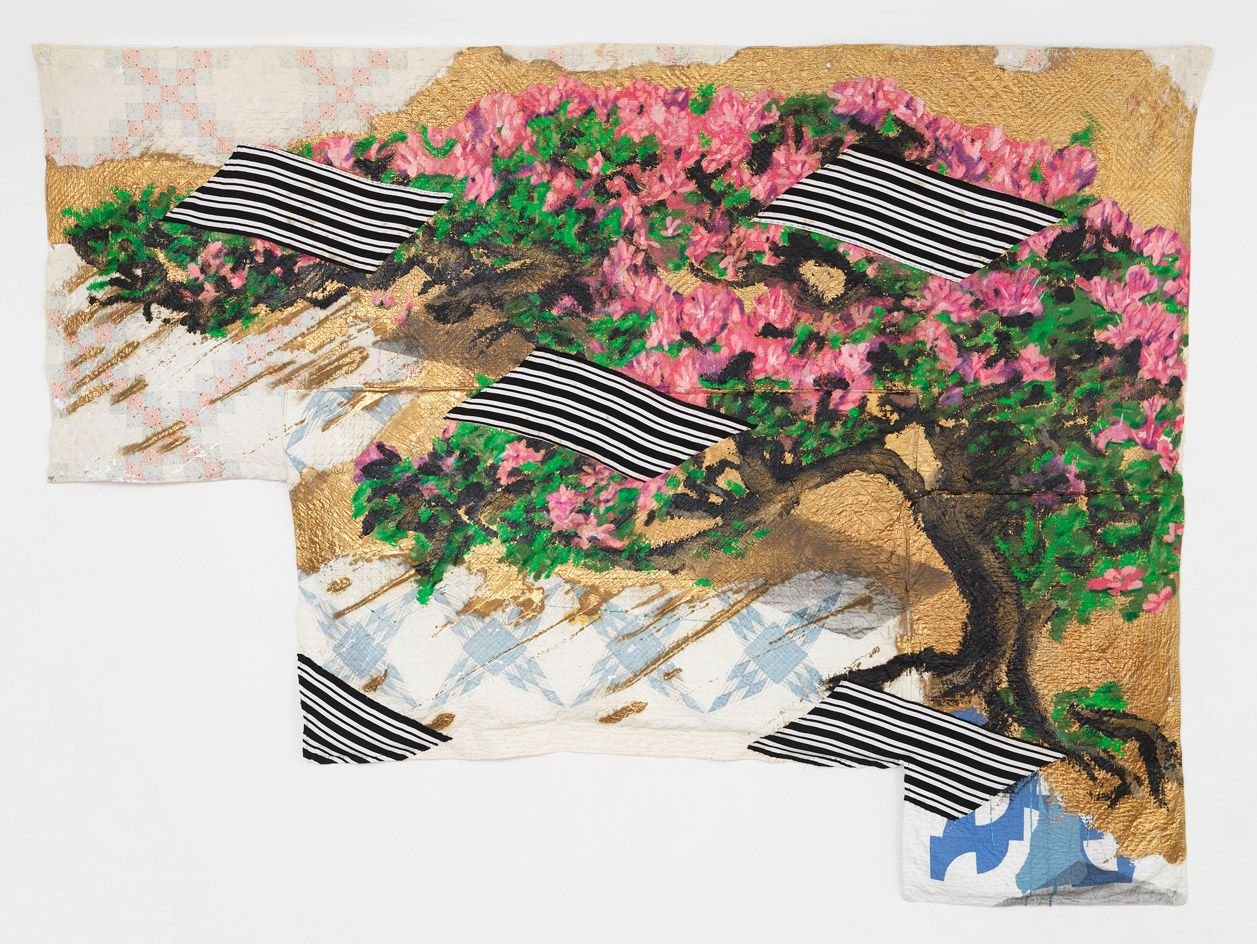
Sanford Biggers, Premise, 2021. Antique quilts, birch plywood, gold leaf.
(Image credit: Photography: Todd-White Art Photography. Courtesy of Massimo de Carlo Gallery)
American artist Sanford Biggers draws connections between apparently disparate cultural practices and examines current socio-political events while unearthing the contexts that conceived them. Biggers’ works reference African American history, ongoing police brutality against Black Americans, and Buddhist spiritualism. The Harlem-based artist’s work spans film, performance, music and sculpture, and he has frequently turned to textile art to explore new narratives, with his quilt pieces often originating as antique heirlooms, which he acquires and alters. As the artist explained of the works: ‘My embellishment, erasure, defacement, and repair complicates the provenance and gender of these relics of Americana. They are remixed, chopped and screwed but their softness is ultimately their power.’
Faig Ahmed

Seyid Yahya Bakuvi (Shirvani), 2021. Faig-Ahmed.
(Image credit: Image Courtesy of Faig Ahmed Studio)
The work of Azerbaijani artist Faig Ahmed is interwoven with complex layers of historical, literary, mystical, and craft. He is best known for surreal, often psychedelic twists to traditional Islamic rugs. His carpets – like optical illusions in textile form – warp, melt, pixelate, unravel, and appear to spill from the wall and onto the floor like intricate pools of liquid. Despite the contemporary interventions, the artist’s textile art is created by skilled practitioners who follow traditional Azerbaijani weaving techniques. Ahmed, who represented Azerbaijan at the Venice Biennale in 2007, presented three new carpet works in his solo show, ‘Pir’ at Sapar Contemporary, New York. Each work is titled after poets and spiritual masters whose works had a lasting influence on the cultural history of Azerbaijan: Shams Tabrizi, Yahya al-Shirvani al-Bakuvi, and Nizami Ganjavi.
Tanya Aguiñiga

Tanya Aguiñiga, Extraño 2, ice-dyed cotton rope, synthetic hair.
(Image credit: Courtesy of Volume Gallery, Chicago and the artist)
Textile artist Tanya Aguiñiga, now based in Los Angeles, spent a childhood in Tijuana, Mexico. During this time, she travelled several hours each day across the border to attend school in San Diego, an experience that would go on to have a profound impact on her work. Her furniture, textiles, wearable pieces, sculptures, and site-specific installations involve a spectrum of natural materials, from beeswax to human hair and stitch together complex ideas of gender and nationality. Beyond her individual practice, Aguiñiga frequently collaborates with artists and activists to create sculptures, installations, performances, and collective community-based art projects. These ‘performance crafting’ happenings explore notions of divided, transnational identities, political and human rights issues at the US-Mexico border, and the power of art to weave communities together.
Sheila Hicks

Portrait of Sheila Hicks, 2011.
(Image credit: Giulia Noni)
Sheila Hicks’ name is almost synonymous with fibre art. Over more than half a century, she has removed the seams between art, architecture and design with bold, groundbreaking work, often dominating public spaces. The American artists’ extensive travels across several continents and studies of vernacular textile traditions informed an expansive, yet unmistakable practice that ranges from intricate wall hangings (or ‘minimes’) to cascades of vibrant fabric balls and maximal site-specific installations which envelop viewers and overwhelm senses. Hicks’ work draws on everything from Peruvian and Bolivian archaeological sites to pre-Columbian textiles. She was also deeply inspired by her former Yale tutor Josef Albers’ approach to colour and the pioneering structures in the work of his wife, Anni Albers. American design firm Knoll became one of Hicks’s first major commercial clients; together they created Inca, inspired by Andean patterns. In Hicks’ work, textile art is sculpture, painting, architecture and an independent discipline in its own right.
Chiharu Shiota

Chiharu Shiota, Circulation, 2018. Installation: metal rings, red wool Valletta 2018 European Capital of Culture, Valletta, Malta.
(Image credit: Photography: by Daniel Mifsud Copyright VG Bild-Kunst, Bonn, 2021 and the artist)
Chiharu Shiota’s elaborate entanglements are difficult to forget and easy to get lost in. Her labyrinthine installations are vast, surreal waves of blood-red, black or white threads, and appear almost as though humans could weave webs. Within these environments, the Japanese, Berlin-based artist often traps objects of personal significance such as clothes, keys, boats, suitcases, and even herself. Shiota’s work is deeply rooted in performance art; the artist studied under Marina and holds a deep affinity with late Cuban-American artist Ana Mendieta. Her textile installations are both performative and painterly; as the artist told us, ‘The single line of thread is like a line in a painting. With the thread, I am drawing in the air, in an unlimited space. With the material, I can create new spaces. They might be deconstructed after the exhibition, but they will live in the memory of the visitors forever.’
Billie Zangewa

Billie Zangewa, An Angel at My Bedside, 2020, Hand-stitched silk collage.
(Image credit: Courtesy the artist and Lehmann Maupin, New York, Hong Kong, Seoul, and London)
South African–Malawian artist Billie Zangewa is well known for creating moving stories of femininity, domesticity, motherhood and the exploitation of the Black female body rendered in delicate hand-stitched fragments of raw silk. Within these scenes, often figurative, urban and referencing themes of everyday life, Zangewa explores gender stereotypes and socio-political notions around the undervaluing of women’s labour. Through self-portraiture, the artist also critically confronts the male gaze, and conversely, explores what a female gaze on womanhood might look like.
Gabriel Dawe

Gabriel Dawe, Plexus No. 31, 2015, Site-specific installation at the Newark Museum, Newark, NJ
(Image credit: press)
Best known for his dazzling Plexus series, Mexican artist Gabriel Dawe is well versed in pushing textile art to its extremities. His vast installations explore the intersection of fashion, architecture and optical illusion. Dawe takes the core component of clothing, and augments it on an architectural scale, creating hypnotic work which seems to make the tangible appear intangible. The artist uses ordinary polyester embroidery threads to create extraordinary illusions which resemble something close to vivid, laser projections. Beneath his work’s obvious aesthetic appeal, Dawe speaks to something deeper: the human need for shelter and protection, and the hyper-masculine ideals prevalent in Mexican culture. gabrieldawe.com
Anna Ray

(Image credit: Image courtesy of Anna Ray and House on Mars Gallery. Photography: Alun Callender)
Anna Ray has a knack for harnessing the emotive power of her materials. Through large-scale, handmade work and avid experimenting, she blurs the boundaries between the two- and three-dimensional with wall-based pieces that almost assume the quality of sculptural reliefs. Predominantly fibre-based, the artist’s work spans silk, cotton, velvet, wool and paper, often using humble, domestic materials such as a sewing machine, scissors, pliers and a needle. Earlier this year, Ray became the second recipient of the Brookfield Properties Crafts Council Collection Award at Collect 2021. The artist charmed the judges with her ability to exude joy, optimism and energy through her sculptural works. As part of the award, her striking pieces, Capture and Weave (made during and directly after the first UK Covid-19 lockdown) was exhibited at 99 Bishopsgate and Aldgate Tower in summer and autumn 2021.
Diedrick Brackens

Diedrick Brackens, summer somewhere, 2020, woven cotton and acrylic yarn.
(Image credit: Courtesy of the artist, Jack Shainman Gallery, New York and Various Small Fires, Los Angeles)
Texas-born Diedrick Brackens’ rich tapestries interweave personal stories, American history and narratives of African American and queer identities. Fusing techniques and traditions from West African weaving, quilting from the American South and European tapestry-making, he creates intricate, often vibrantly-coloured visions of history, folklore and contemporary American life. Created in hand-dyed cotton, his pieces are charged with a consciousness of the material’s complex and barbaric history. Since receiving the revered Studio Museum in Harlem’s Joyce Alexander Wein Prize in 2018 (an honour previously awarded to the likes of Simone Leigh, Lorna Simpson and Glenn Ligon), the artist has become a pivotal figure in the contemporary fibre art renaissance.