
[ad_1]
The conservator Nicole Grabow has spent thousands of hours vacuuming fine art.
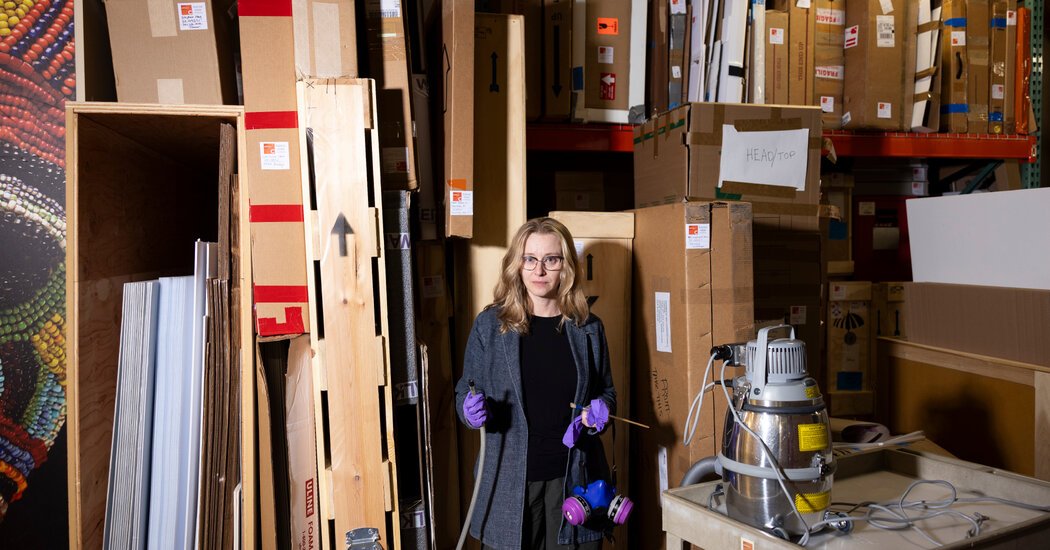
In her Minneapolis office, Grabrow demonstrated how to use a canister vacuum bought on Amazon for $100 to remove dried mold from a painting. With one hand, she steadied the hose over her shoulder and, with the other, made small strokes with a tiny paintbrush.
“We don’t want to suck up part of the artwork, right?” she said. “We want to have control of the suction so that we’re being really gentle, especially if we’re working with delicate, fragile, friable surfaces.”
Recently, she removed mold from about 20 fine art paintings from the 20th century. (The titles of serviced artworks are confidential, she said.)
“They were furry,” Grabow said. “It was really extreme.” The task became a process of deciding which pieces could be saved versus which needed to be taken out of the collection, she added.
As one of the few trained conservators in the field of art and cultural heritage emergency response, Grabow teaches people around the world how to remove mold from artwork, along with other salvaging techniques.
She said the demand for these skills had grown as climate change increased the frequency of intense weather events such as wildfires and flooding that put collections in danger.
“There are more severe storms. There’s more severe flooding in the spring season,” Grabow said. “Emergencies almost always involve water. If there’s fire, there’s water; if there’s water, there’s water.”
She added: “There is also more emotional energy in emergency planning and preparedness. People are very worried.”
Grabow does this work as the director of the preventative conservation department at the Midwest Art Conservation Center. The department provides resources and guidance on disaster preparedness to art and cultural heritage stewards, such as state agencies, institutions, museums, galleries and private individuals.
Only a few outfits around the world do this kind of art emergency response work, including the Conservation Center for Art & Historic Artifacts in Philadelphia, the Culture Emergency Response nonprofit in the Netherlands and Artlab Australia, a state agency in South Australia.
From her base in Minnesota, Grabow advises gallerists on the secondary effects of wildfires. In recent years, smoke from Canadian fires has become an air quality issue in art spaces in the Midwest.
“The wildfire is definitely something that I had never seen in this area until a couple of years ago, and now people talk about it every summer,” she said. “Over the long term, any kind of pollutant is going to contribute to the overall degradation of materials.”
The center provides in-person support for a fee, but it also has a free emergency response hotline available 24 hours a day, seven days a week. Grabow said she tried to keep advice simple and low-tech, such as buying a cheap vacuum, rather than the “conservators vacuum” that she uses, the Nilfisk, which can cost thousands of dollars.
“We can help counsel people on how to do triage.” she said. “Especially when we’re working with these collections caretakers and these small institutions that don’t have any funding, it’s helping people to rely on their own judgment, and their own common sense is a huge part of it.”
So what should one do in an area affected by wildfire smoke?
“Your nose is a tool. Use it. If the air smells weird, it probably is, so change your filters,” Grabow said, recommending air filters that catch not only smoke particles but the much smaller mold particles.
Flooded art storage? Transport objects to air-dry in a clean space.
“You have 72 hours after a water incident before mold begins to grow,” Grabow said.
Not enough time or space? Freezing halts mold growth, so find a freezer or hire a freezer truck.
“The freezing buys time,” Grabow said. “Then you can unfreeze and dry at your leisure.”
On the other side of the world in Adelaide, Australia, the conservator Sarah Feijen gave the same advice.
“We know all the suppliers of transportable freezers and freezer trucks,” Feijen said, laughing.
Feijen is the director of the state agency Artlab Australia, which advises individuals and institutions on similar methods through their emergency hotline and on-the-ground services.
At the end of 2019, a bushfire blazed across the Adelaide Hills, destroying more than 80 homes and 88 square miles of land. While Feijen said the area had not seen bushfires of that scale since, there had been an increase in localized fires because of an increase in “the frequency and the severity of rain and downpours.”
Paradoxically, Feijen said, the increase in precipitation spawns vegetation growth, which in turn can increase the fuel load for bushfires.
“If we’re talking about a fire or a flood, what mostly we’re dealing with are wet and dirty artifacts,” Feijen said.”
While emergency response services are vital, they’re a Band-Aid. Feijen said stewards of collections, large or small, need to focus on emergency preparedness.
“The things that you do to prepare are quite straightforward, but you need time and space to think about it beforehand, rather than in the moment,” Feijen said. “What’s most important? What does it need? Have I got somewhere to put it? Where are they going to go?”
In the United States, Grabow is encouraging collection managers to ask these kinds of questions on a larger scale about public art. She pointed to a 2017 finding by the Americans for the Arts nonprofit that only 13 percent of public collections programs surveyed had an emergency preparedness response plan.
Grabow is developing an emergency tool with fellow preventive conservator Maddie Cooper of the Conservation Center for Art & Historic Artifacts in Philadelphia. The project, which is funded by the National Endowment for the Humanities, is called “Protecting Public Art: The Future of Risk Assessment and Mapping.”
The project will create a free online risk assessment that overlays mapping data from public art collections with the FEMA National Risk Index map. The goal is to help collection managers identify which artwork sites are most vulnerable to which type of natural hazard, be that a hurricane, flood or wildfire.
“We can take the collections data, we can take the location and we can take the FEMA data, and we can develop a profile for each artwork that tells you its risk assessment,” Grabow said. “It’s trying to predict the future.”
[ad_2]
Source link