

[ad_1]
I have always wondered why Marc Chagall’s images are floating and his figures flying, why his compositions seem to resist gravity not merely as a physical force but as a metaphor for the weight of time, history and sorrow. In his pictorial universe, there is a sustained refusal to anchor the human form to the ground, a poetic elevation of bodies, animals, instruments and flowers into an aerial realm where emotion assumes precedence over mass and memory takes precedence over chronology.
This is not an aesthetic quirk nor a surrealist indulgence, but rather a visual philosophy rooted in the internal architecture of longing – an architecture in which the laws of perspective dissolve under the influence of desire and narrative space becomes emotionally rather than physically coherent. Chagall’s flight motif operates not as an escape from reality but as a reconstitution of it through the logic of affect, where love, grief and devotion are granted spatial autonomy.
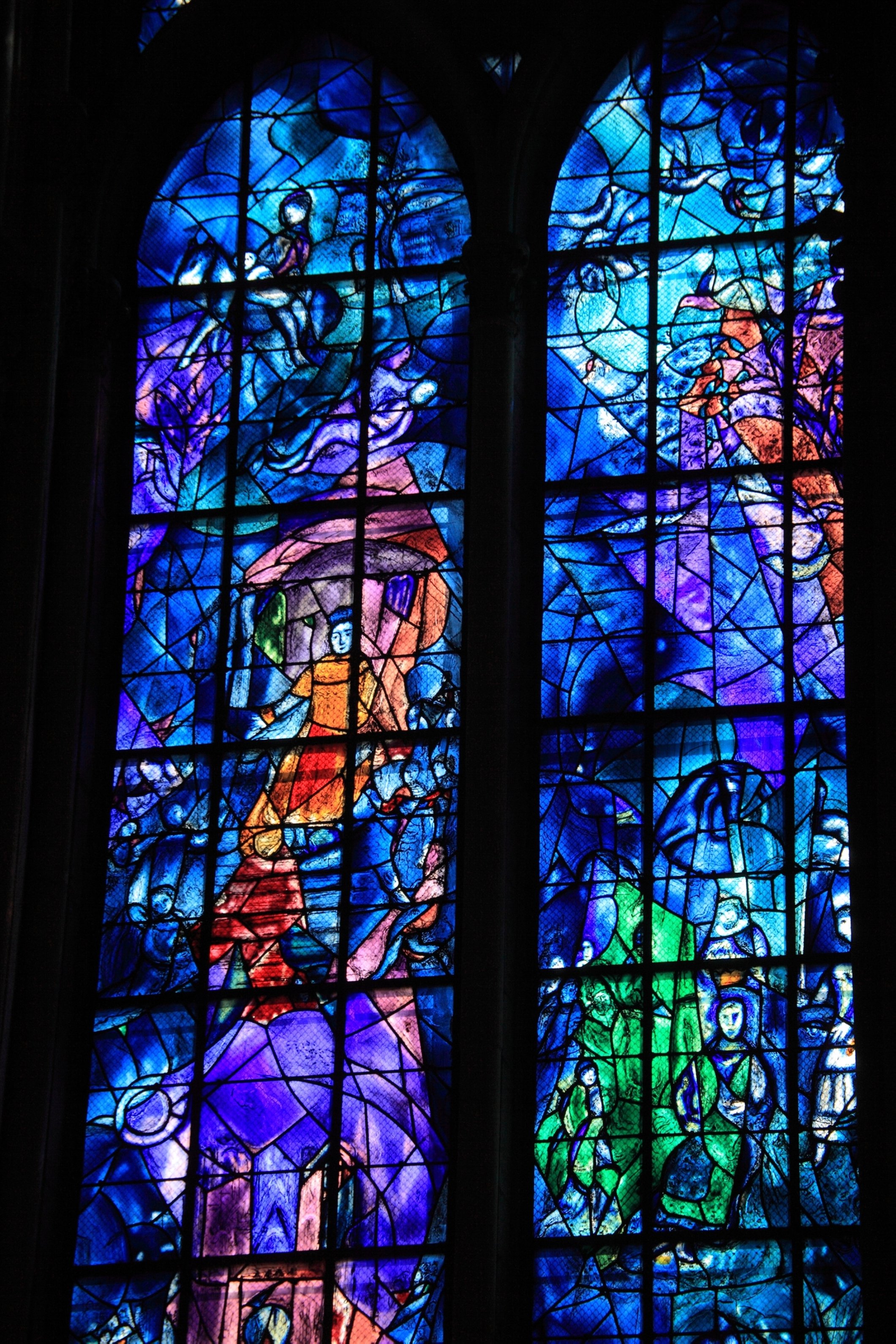
Engaging with Chagall’s work is not about analyzing a set of symbols but about entering a visual syntax shaped by reverie and psychic necessity. His floating lovers, his celestial violins, his twilight animals all articulate a world in which the emotional truth of experience surpasses any empirical representation of it. In this sense, Chagall’s work cannot be confined within the boundaries of style or school; it emerges instead as a sustained act of visual remembrance – a painterly reconstruction of a reality filtered through loss, exile and transcendent attachment.
Born in 1887 in the shtetl of Vitebsk, in what is now Belarus, Chagall emerged from a world rich in Jewish mysticism, rural folklore and communal intimacy – a world already vanishing. His father carried herring barrels. His mother encouraged education. From a young age, he understood the fragility of life and the urgency of memory.
Though he would later study in St. Petersburg and flourish in Paris, his art never severed from the mythic symbols of his childhood: goats, fiddlers, the crescent moon, lovers cloaked in twilight. These motifs weren’t decorative. They were spiritual scaffolding, keeping the structure of his inner world intact even as history threatened to demolish it.
Unlike many of his contemporaries, Chagall was never seduced by modernity’s clean lines or industrial optimism. He remained loyal to irregularity, asymmetry and emotional rupture to the dream.
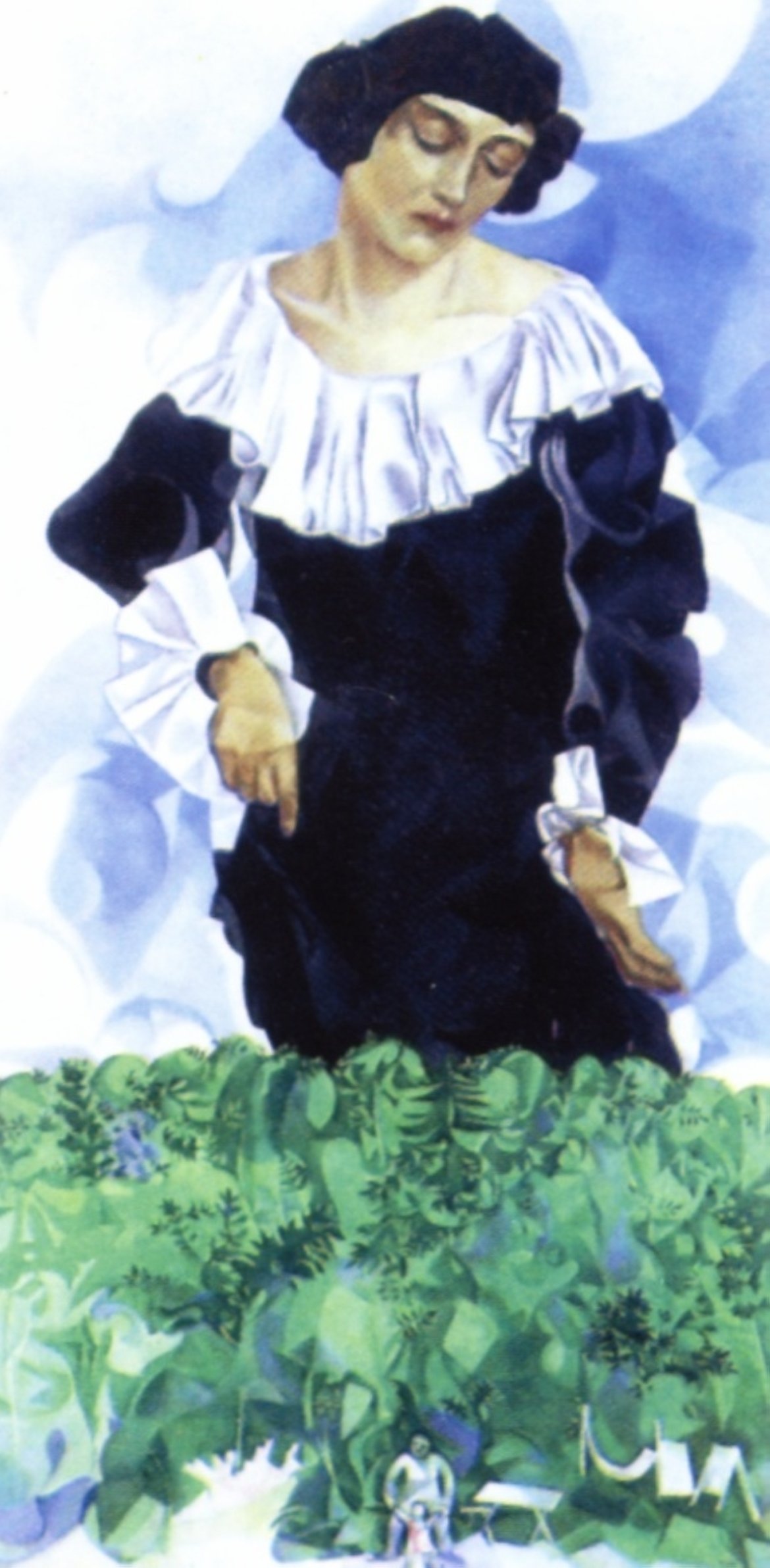
In 1909, Chagall met Bella Rosenfeld, the daughter of a wealthy jeweler, and instantly declared, “Her silence is mine. Her eyes, mine.” She would become not only his wife and companion, but the gravitational force of his entire visual language. Bella did not merely appear in his paintings.
She inhabited them, haunted them, hovered through them – often levitating in his arms, her face tilted toward the heavens, her body suspended in ecstatic stillness.
Even after she died in 1944, Bella remained a symbol of immortal love and loyalty. And she turned into a myth in Chagall’s art.
Artist and muse
What is it about the relationship between art and love, real love, not the diluted, performative kind that artists so desperately require? Perhaps because the act of creation is fundamentally irrational and love is the only equally irrational force powerful enough to match it. In its deepest, most mythic sense, the muse is not merely a person.
She is a keyhole to the self. A portal through which the artist re-encounters the most vulnerable, poetic aspects of their psyche. Like Chagall-Bella’s love, she was not just an inspiration. She was Chagall’s return to safety, to childhood, to color, to the memory of being held without needing to explain oneself, floating to eternity together.
In a world that had repeatedly displaced him, from Russia to Paris, from Europe to New York, Chagall’s painting became a quiet revolution. His floating figures represent psychic freedom, a refusal to be pinned to the earth by trauma, exile, or historical violence. Where the modern world was industrializing and brutalizing the body, Chagall’s lovers soared. His refusal to submit to realism – his resistance to proportion, gravity and even time – was an aesthetic form of psychological survival.
One could also read the floating couple as a return to the pre-Oedipal, the oceanic unity between mother and child, before separation. A Freudian “primary narcissism” is not a pathology, but a longing and desire to be in undivided union with the beloved. In this sense, the act of painting the floating lovers was Chagall’s return to an internal Eden. To float, then, is to remember what it was like before loss.
While the 20th century churned forward, mechanizing life, rationalizing aesthetics, and politicizing art, Chagall remained defiantly lyrical. He painted violins when the world wanted factories. He painted lovers when the world gave him war.
This was his resistance. He once said, “Only love interests me and I am only in contact with things I love.” Perhaps, in the end, this is what gives Chagall his immortality: Not just that he painted love, but as if love were the only thing left worth saving.
They say when an artist loves you, you cease to belong only to time. You become more than memory, more than presence, you are transfigured into image, color, rhythm and form. The beloved of the artist is not merely remembered; she is repeated into permanence, rendered again and again through brushstroke and symbol until her absence becomes indistinguishable from a presence that lingers across canvases, decades and eyes. In Chagall’s world, Bella did not die; she floated endlessly through pigment, hovering in eternal tenderness above a village no longer there. This is the final and most mysterious act of artistic love – the transformation of the ephemeral into the eternal.

[ad_2]
Source link