
[ad_1]
Jewel just ate a Pop-Tart. She tells me this after entering our video chat, dialing in from an art studio in Telluride, Colorado, where she has been living and working for the past decade. She appears fresh-faced, her skin dewy and glowing. Her form-fitting black top stands out against a vividly printed cloth backdrop—a gift from a fan. There’s an ease in her demeanor, her voice steady and breathy. There’s both assurance and intimacy in her tone, even when admitting to needing a midday snack.
It is this same kind of openhanded honesty that has resonated with critics, fans, and admirers since the ’90s. Jewel was propelled to music superstardom with her 1995 debut Pieces of You and 1998 follow-up Spirit—albums that helped define a particular strain of folk-pop—after a mythologized upbringing in an Alaskan homestead and being homeless at 18. Her catalog is introspective and disarmingly direct. Songs read like diary entries, confessions that are at once deeply personal and universally relatable. This emotion also defines her work as a visual artist, a throughline that carries across her painting and mixed-media practice.
Now 51, Jewel (née Jewel Kilcher) is about to debut her first solo art show, “Matriclysm: An Archaeology of Connections Lost.” Held at the Salone Verde from May 7 to Nov. 22, 2026, the expansive exhibition will coincide with the 61st Venice Biennale. Thirty works, spanning painting, sculpture, tapestry, and sound installations, are arranged across a series of immersive rooms that unfold one into the next. The show moves through what she calls “matriclysm,” where themes of feminine inheritance, rupture, and repair sit side by side. Crone-like figures merge with trees and cultural fragments, while mother-and-child studies and symbolic still lifes coexist with works that turn oceanic and celestial data into shifting sound and light.
The project traces back to “The Portal: An Art Experience by Jewel,” her 2024 institutional debut at Crystal Bridges Museum of American Art, which marked the first time her visual work was presented publicly within a curated museum. That presentation ultimately led Crystal Bridges to extend the collaboration and support her next step: introducing Jewel as a fine artist with her first solo show at one of the most significant stages in contemporary art.
Alongside her deep dive into a new industry, she is a mother, and she still writes music, even if she doesn’t tour much anymore and feels less drawn to the machinery around it. She has also spent decades working in behavioral health, building school curricula and a nonprofit. And, as she tells me, she doesn’t treat any of it as separate from the rest. The same instinct runs through everything: the need to stay honest about what she’s making and why. Visual art isn’t something she’s adding on later in life; it’s another way of telling the truth of what’s in front of her.
By the time our call winds down, she reaches for another bite of the Pop-Tart, still talking with that same ease. The version of Jewel people have long known—direct, casual, unguarded—comes through, on her own terms.
I want to congratulate you on your upcoming exhibition. What stage are you in as the show approaches?
Thank you! The museum invited me almost a year ago to present during the Biennale, and I didn’t have a concept yet. From then to now, I’ve created 30 new works. And they’re all finished, actually.
Are you presenting all 30 or are you editing them down? What was the process like?
I created a concept called “matriclysm.” It’s a made-up word of the matriarchy plus cataclysm. It’s about cataclysmic events for the matriarchy. There are three large-scale sculptures that represent undiluted feminine power, and the rest starts to explore an unraveling, both in my own life and globally. Every piece builds from one to the next as people travel throughout three spaces.

Jewel with her piece “Heart of the Ocean,” which will be part of her “Matriclysm” exhibition.
And how did you come to this theme?
It’s just what’s been moving me. I make work because I need it. I make work because something’s on my mind or in my heart, and I need to understand and explore it. It’s like having medicine. I have a really complicated relationship with my mom, with femininity. I moved out at a really young age. I was raised by a single dad. It’s just a topic that I wanted to explore more, and something that I see globally. I really think that when we lose contact with feminine principles, we lose the ability to connect deeply. We need to nurture this connection. The disconnection of self, of community, and extending that to the planet can really be traced to the suppression of a feminine memory, a feminine perspective. That’s what the show explores.
This sounds much like your music, which feels deeply rooted in femininity and in nature, something fixed in place, yet it also carries a sense of movement. How do those two impulses coexist in your artistic practice?
Yeah, those are very prevalent in my artistic practice. Nature really shaped me, being raised in Alaska. And I had this sort of epiphany in a bathtub one day: What if I could create an instrument that nature played? If I was really loyal to the mathematics of nature, could people [who are] seeing it indoors, listening to it indoors, be affected in the same way as if they were outdoors?
With this in mind, I set about building the first sculpture, called “Heart of the Ocean.” It’s eight feet tall. There’s a computer in its base, and I worked with NASA to create what I call a data sculpture. It’s livestreaming oceanic data. It chooses a sound vocabulary and a light vocabulary, so as the ocean changes, the sound and lights change constantly. And then we had it studied. We’re in preliminary phases with neuroscientists and physicists that are tracking the effects of it on your brain, and it’s showing that it gets people into theta brainwave states [which denote deep relaxation] in like 20 seconds. It recreates the feeling of being outdoors, which for me is just really encouraging.

Jewel’s art show, “Matriclysm: An Archaeology of Connections Lost,” consists of 30 unique pieces.
It’s interesting that you’re involving sound and music. Was it a conscious effort to integrate it within the visual experience, seeing that you’re a musician?
No, I’m actually really surprised by it. I didn’t know I’d be making data sculptures. I didn’t know that this would be such a big part of my life. But these instruments that I’m making, that give nature a voice, just had to be integrated into my art. It’s an interesting place for my music to go. It’s very different. If you hear the “Heart of the Ocean” music, it doesn’t sound like me at all. It sounds eerie and strange and otherworldly.
I also have another data-light sculpture that uses the light wave radiation of the seven stars of the Pleiades [star cluster], and I gave them each a woman’s voice. That one actually sounds much more like me. It’s a 12-minute choral, but it’s played by the actual star data. I like it a lot.
I’ve always had a private art practice. Nobody knew about it because my music career has been so public. And then there’s my work in behavioral health—I’ve spent 25 years developing school curricula and building a nonprofit. I’ve been in that space for a long time, and it all existed in separate silos. And with this portal, which was my debut into the art world, it was about integrating all three of these things. I was able to curate the contemporary collection through this lens of mental health, and I was able to use music in a different way that kind of accesses your nervous system and regulates you. I get to finally integrate these three aspects of my personality into one space.

Jewel blows glass for her piece “Seven Sisters” in a studio at the Toledo Museum of Art.
With all your different practices, there seems to be a clear courage in the way you allow honesty and vulnerability into the work. What does it take for you to hold that openness while making and also showing it?
It was a choice really early on. I was discovered when I was 18, and I was kind of at a crux. Like, how are you going to go about this? This is a job that absolutely ruins people. You take somebody with my background and when you add fame, it doesn’t tend to go well. I decided that safety was in vulnerability. Safety was in telling the truth.
If I began to lie about myself to make myself seem better, if I began to use my own art as propaganda to make myself seem more perfect or more polished than I was, I would be in a really dangerous position. So I decided to lead with honesty, to beat people to the punch, to tell the truth about myself. I find a lot more safety in it. I have room to grow as well.
I’ve switched genres, I’ve switched mediums. I went to poetry, which was a huge no-no. I switched from folk to pop—another big no-no. You have to do what your heart tells you. You have to obey it. If you don’t, you pay such a big price, because if you compromise what you are in order to be liked and people still don’t like it, you’re in a really bad position. Not everybody’s gonna like what you do.

Behind the scenes with Jewel in the studio.
You mentioned that art is a form of medicine for you. And in the past, music was that kind of healing for you. You’ve practiced art privately before, but has fine art replaced music professionally?
I don’t know if I’d say replacing. I don’t tour much—I don’t like touring. I write all the time, but I don’t really like promoting music. Visual art is what I’m doing now, and I’m having maximum levels of fun with it. I didn’t think in my fifties I’d get to have this much fun, like when I was 18. It’s full of discovery. It’s powerful for me personally. It takes all of my talent, and executing it challenges me, which I really like. I don’t know if this is my future, if this is what I’ll keep doing. I’ll probably continue to integrate all these parts. But I might still put out a record.
What does it say about your mindset that you have such disparate mediums on display? You have tapestries, you have oil paintings, you have a drone show, you have music. It’s all different.
I’ve always had that ability in music. I’d write a folk song, a pop song, a country song—it’s authentic and effortless for me. Certain songs need to be told in a certain way. That just is what it is. For me to force “Intuition” to be “You Were Meant for Me” would be psychotic. It just wouldn’t work. Those are two different things that require two different ways of expressing them. A poem needs to be a poem—it’s not a song. It really comes down to storytelling, honoring what the story needs. That dictates the medium.
I did learn, through music, that if you start one way, people don’t like you to switch—it’s uncomfortable for them. So I knew right away with art, from my very first show with Crystal Bridges, that I would be presenting video art, sculpture, painting, and drone work. From the start, I was letting people know I’m a multidisciplinary artist. I always will be. It’s how I’m wired.

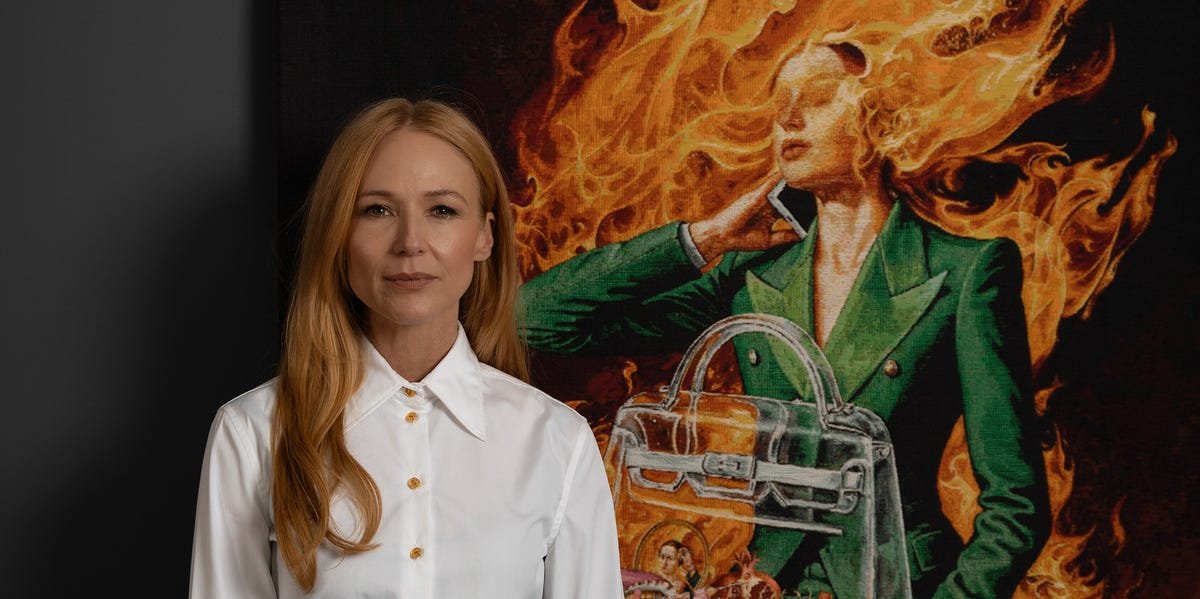
Jewel’s painting “Nepo Baby” (pictured above), from her “Ceremony”series, will debut in “Matriclysm: An Archeology of Connections Lost.”
People may not know that you studied sculpture at Interlochen. I thought you would go there for music.
I did go in through a vocal scholarship. I was a bar singer and ending up at a place that did classical music was mind-blowing to me. There’s world-class teachers, and so I became a double major and a double minor. I did a minor in dance and theater and I majored in visual art. Nobody had ever done that before there. But I told my dean, “Look, I have one year here until my scholarship runs out, and you cannot deny me the chance to learn while I’m here.” So I skipped lunches. Now I think it’s a more common thing. They’re letting kids double major, double minor. I had people telling me that I had to have one focus, and I’m like, “I am, but I’m going to focus on everything now to create a unified thing later.”
Does that mean we’re going to see a Jewel dance piece in the future?
Why not? All you have to do is Google me and Beyoncé dancing.
That was for VH1 Divas, right? I remember that. You were good.
No, I just fancy walked. She kept dumbing it down for me.

Jewel stands beside two self-portraits.
Let’s go back to presenting alongside the Biennale. Why did you choose to present your first collection in such a global way? Was it because Crystal Bridges invited you or did you want to go all-out on your first round?
Both of those things. One, Crystal Bridges invited me to do it. It felt terrifying and so exciting at the same time. It was an instant yes for me. Two, I’m really excited to present this body of work.
And where do you see this body of work moving forward?
The show is going to be set to travel. Crystal Bridges is going to travel with it and bring it to other museums. I’m excited for it to be in many places. And then I’ll see what my next show will be. I’m excited to do public works. I’m excited to do more shows.
So, Jewel, the fine artist is kind of here to stay?
Oh, not “kind of,” a thousand percent. I’m a really introverted person. It was God’s joke to make me famous.
Is that really a bad thing?
It’s not natural to me. It’s why I took years off my career. It’s why I never really pursued fame. It’s not how I’m wired. I like making music. I like creating. Right now, I like being in my painting studio.
This interview has been edited and condensed for clarity.
[ad_2]
Source link